AI finance skills are limited by design. Build your own.
Anthropic ships seventeen finance plugins. Daloopa ships twenty-three skills with 487 stars behind them. Reading the code shows where each one stops, and both packages hardcode the same number.
When Anthropic shipped agent templates for financial services, the headlines wrote themselves. One widely shared piece announced templates "that can replace junior analysts in 2026". Finance LinkedIn ran with it for a week.
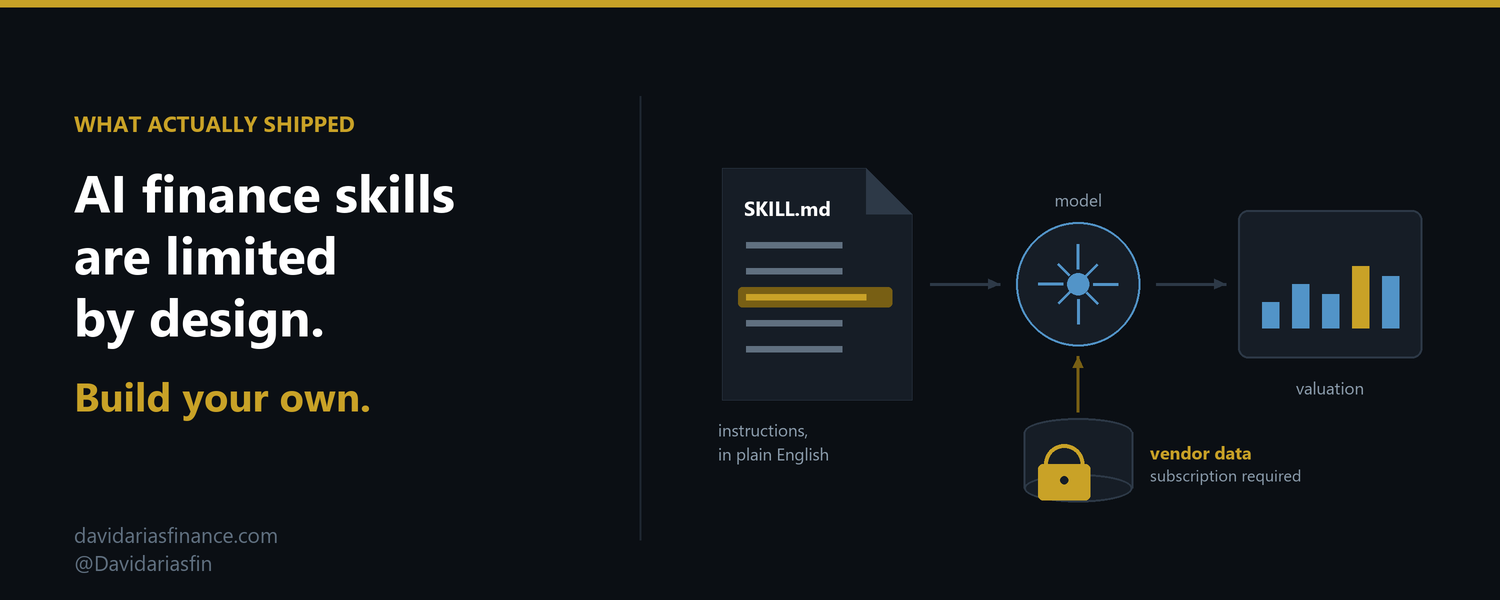
Almost nobody said what a skill actually is.
It's a markdown file. Somebody writes down how to do a job, in English, and the model reads it. No retraining happened. Nothing proprietary got encoded. Ten templates shipped means somebody wrote ten documents.
That gap, between what people assumed shipped and what actually shipped, is most of the story. Anyone who reads the files finds instructions any second-year analyst could argue with, and a few of them wouldn't survive a first-round interview.
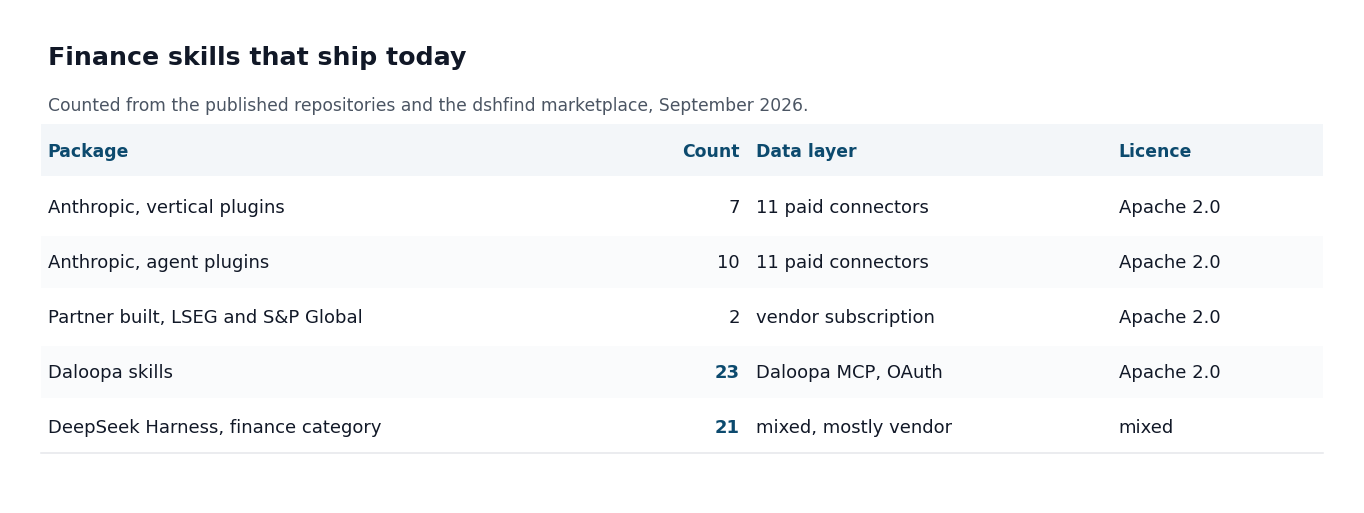
Anthropic's collection runs to seven verticals, ten agent templates, and two partner packages from LSEG and S&P Global. Daloopa's plugin holds twenty-three skills over an MCP server that returns fundamentals linked back to the filing line they came from, and their companion repo is the most starred thing in this corner of GitHub.
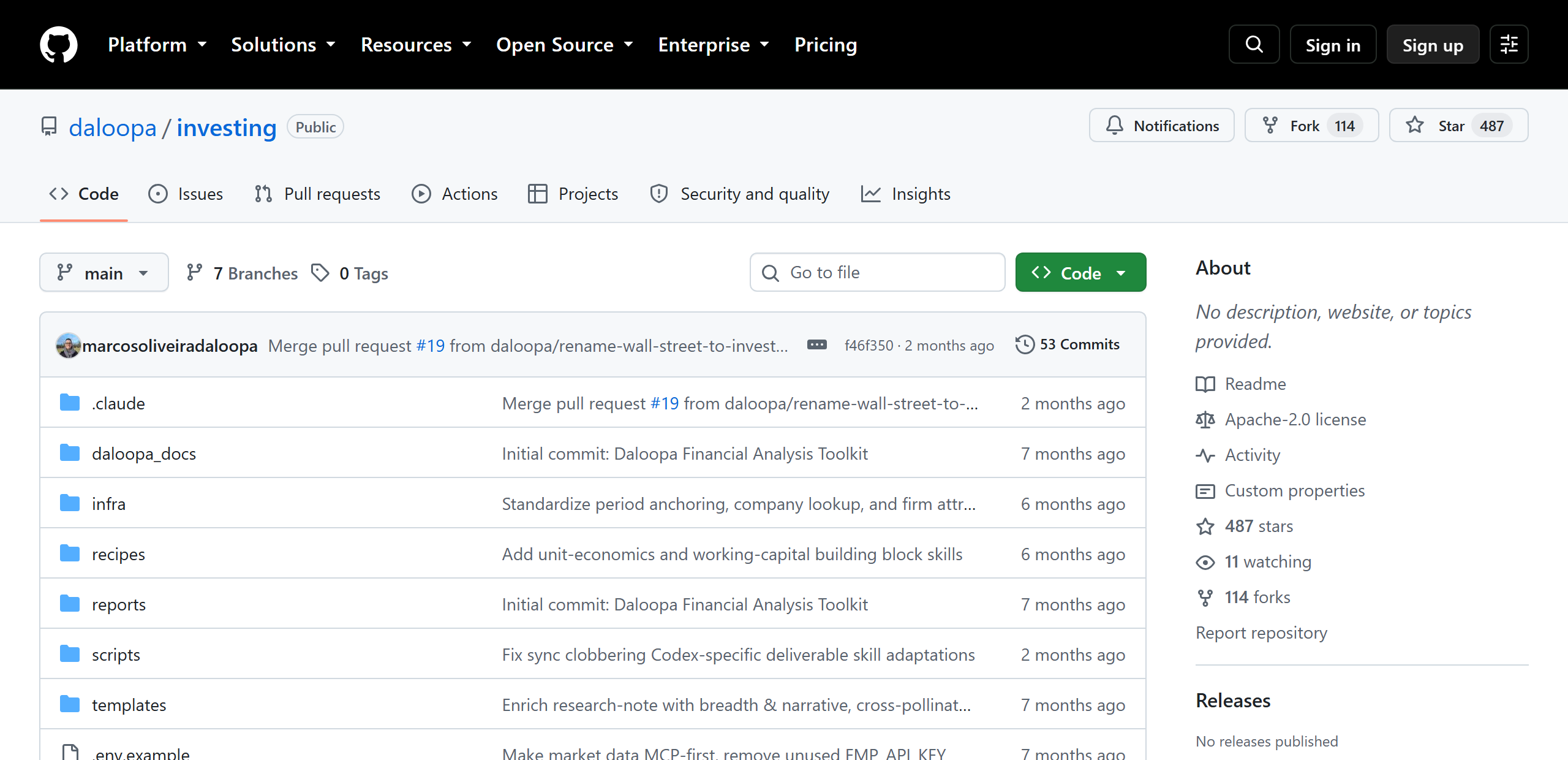
487 stars, 114 forks. For scale, the whole finance category on the DeepSeek Harness marketplace holds 21 plugins and its most popular one has 45 stars.
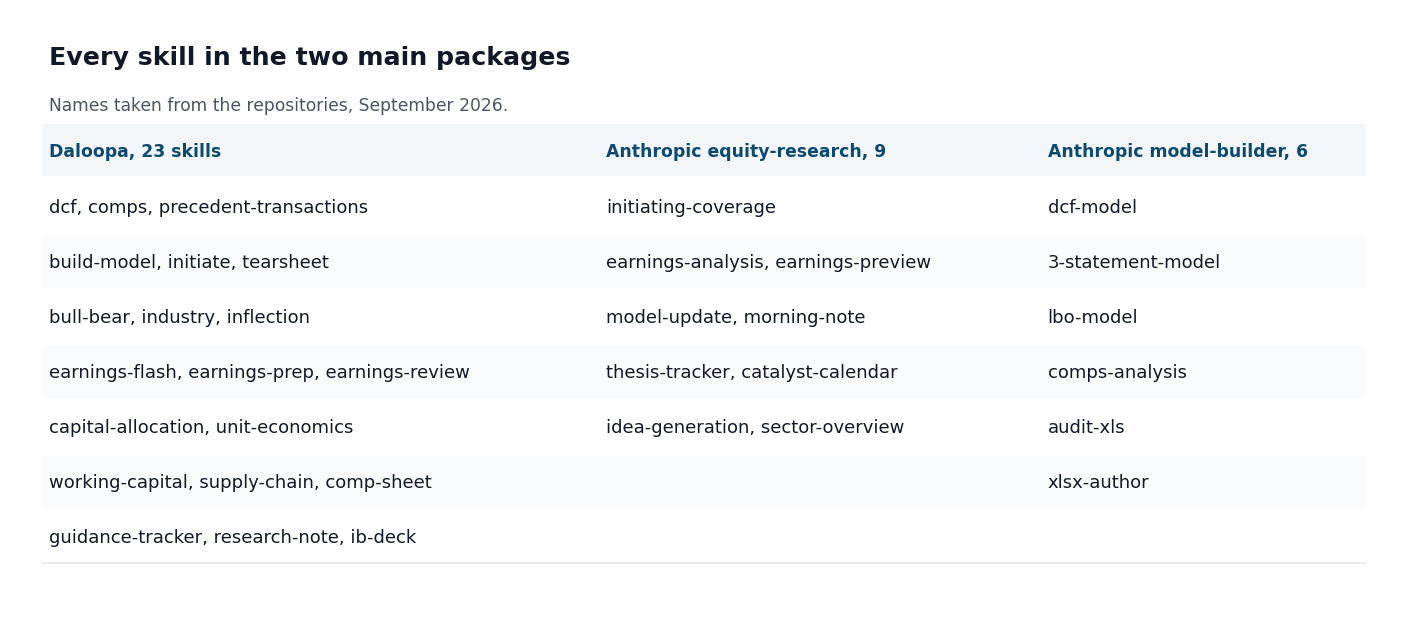
Before pulling any of this apart, it's worth saying the obvious. It's good work. Written by people who have clearly done the job, covering more ground than any individual builds alone, and free.
What a well-built skill looks like
Daloopa's DCF does something most valuation tutorials skip. Instead of projecting revenue as a growth rate that decays toward GDP, it first tries a bottoms-up build off operational drivers, with a taxonomy covering nine sectors.
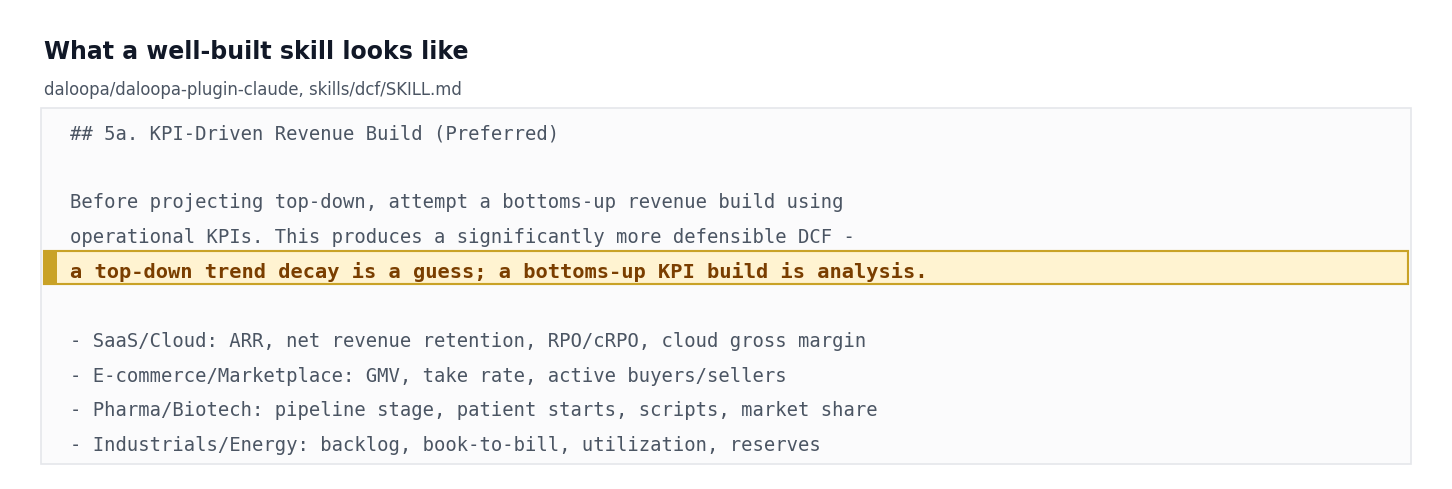
That highlighted line separates a junior model from a real one, and whoever wrote it has built both.
Anthropic's DCF is rigorous somewhere else entirely, aimed at the spreadsheet rather than the forecast.
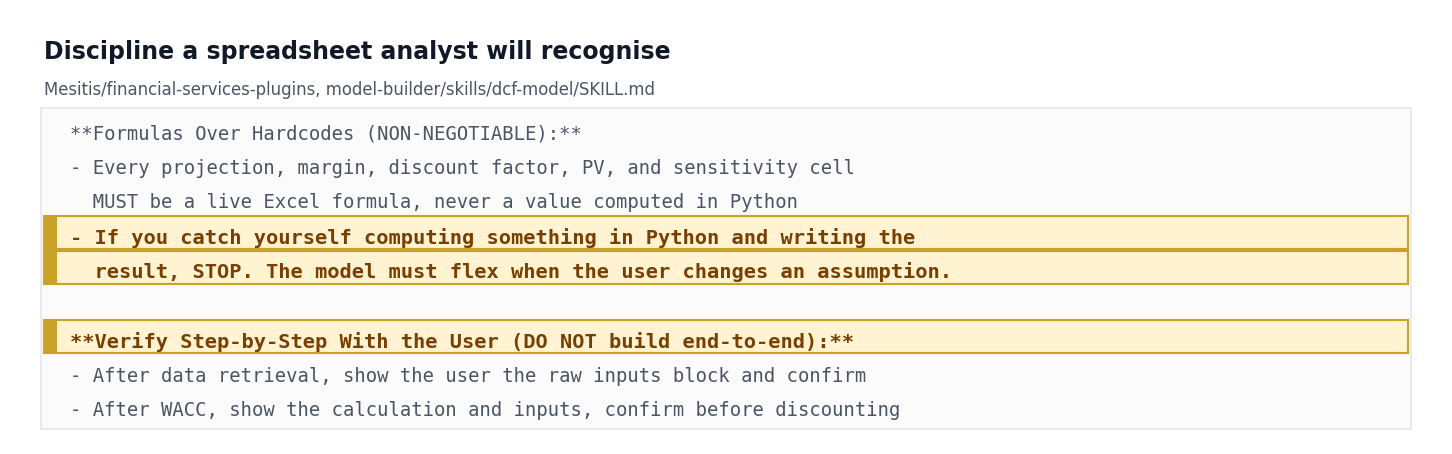
Two rules there that human analysts break every week. Derived cells have to be live formulas, so the model flexes when somebody changes an assumption. And the build pauses for confirmation at each stage instead of running start to finish, because a wrong margin caught after the sensitivity tables are built means redoing everything downstream.
It keeps going. Sensitivity grids need an odd number of rows so a true centre cell exists, and that centre cell has to reproduce the model's own base case, which is a real self-check rather than decoration. Further down, a list of common errors includes "using equity beta instead of asset or unlevered beta incorrectly." Somebody who has reviewed a lot of bad models wrote that.
So none of what follows is about sloppiness. Both packages are careful, the limits turn up anyway, and that's what makes them worth reading.
Both of them hardcode the same number
Daloopa's DCF, four sections after the KPI taxonomy:
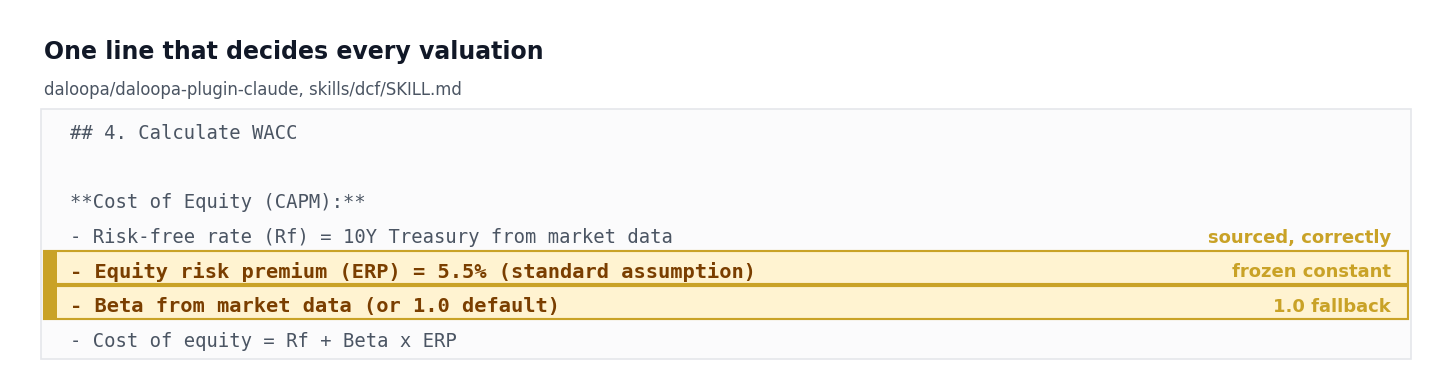
Equity risk premium, 5.5%, called a standard assumption. Beta comes from market data and falls back to 1.0.
Anthropic's DCF, different team, different data philosophy:
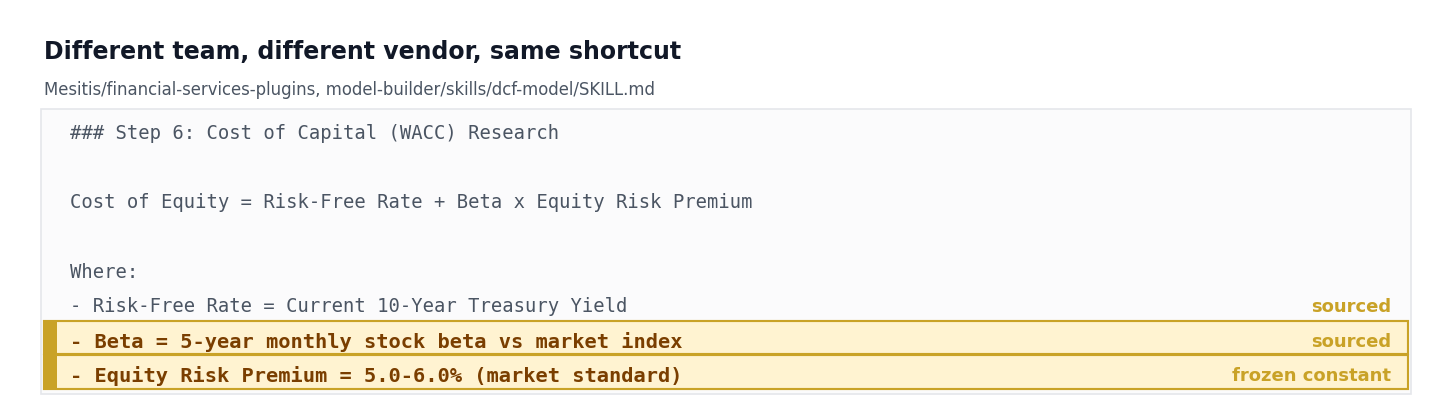
Equity risk premium, 5.0 to 6.0%, called market standard.
Two teams who didn't coordinate, reaching for the same shortcut in the same place. That coincidence is what makes this structural instead of an oversight somebody will patch.
Notice what surrounds it. Risk-free rate gets pulled live off the ten-year Treasury in both skills, correctly. Beta gets pulled from market data. Every neighbouring input is sourced, and the premium sitting between them is a number somebody typed.
Freezing the premium is the kind of thing a valuation course corrects in week three. Damodaran recomputes and republishes an implied premium every month, free, and has done for two decades. Any analyst who wrote 5.5% into a model and left it there through a rate cycle would be sent back to redo it. Yet that's what's shipping inside templates people described as replacing them.
Here's what the constant costs. Same cash flows, same growth, same terminal rate, only the premium moves.
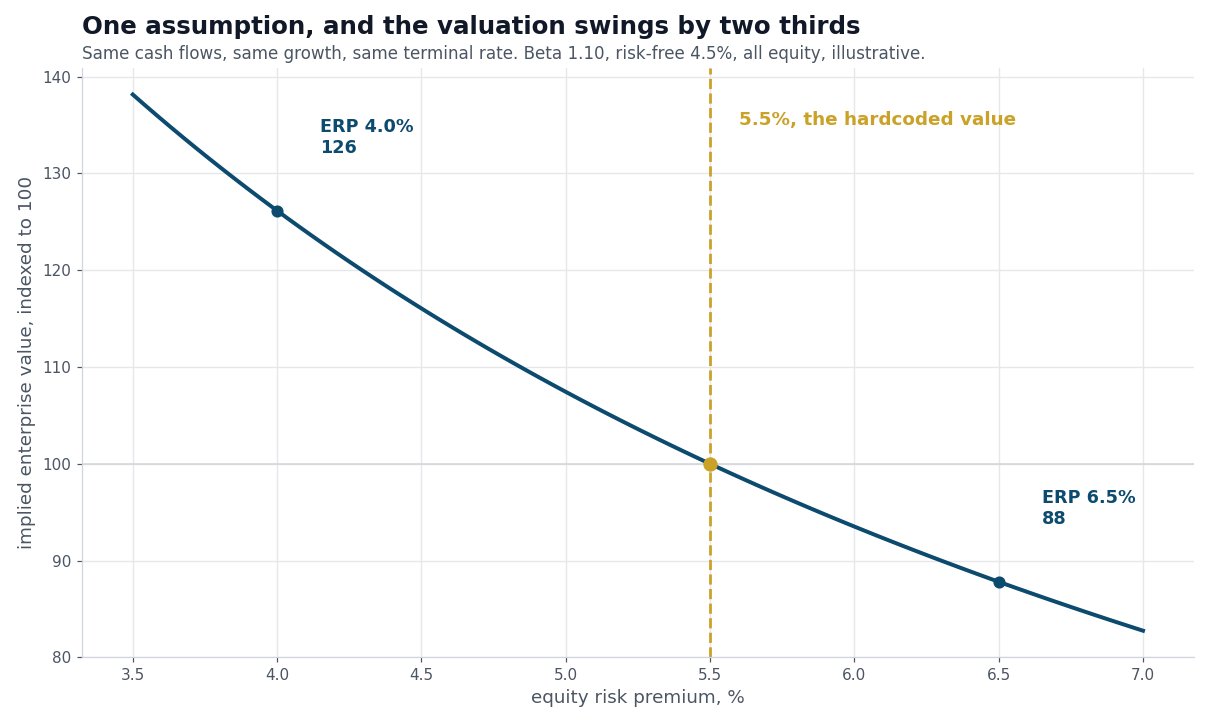
At 4.0% the company's worth 126. At 6.5% it's worth 88. Two thirds of the answer decided by one line of markdown, written once, applied to every company in every rate environment in every market.
Implied premiums have swung roughly between 4% and 7% over the last twenty years, widening whenever something breaks and compressing back down through the calm stretches in between, which is why anyone who values companies for a living recalculates it rather than remembering it. Freezing the midpoint works fine as a default. As a method it doesn't survive a second question.
Nobody sensitises the assumed input
Both packages take sensitivity seriously. Daloopa's DCF builds a sensitivity section. Anthropic's builds three grids: WACC against terminal growth, a multiple grid, and beta against risk-free rate.
Look at that third one. Cost of equity equals risk-free rate plus beta times the equity risk premium, so it has three inputs. Two of them get varied, and the one held fixed, the premium sitting in the middle of the formula, is the only input in the whole calculation that nobody sourced from anywhere.
What lands on the desk is a target price wrapped in a grid of alternatives, which reads as a thorough treatment of uncertainty. And whichever assumption moved the number most isn't in the grid.
Where the data actually comes from
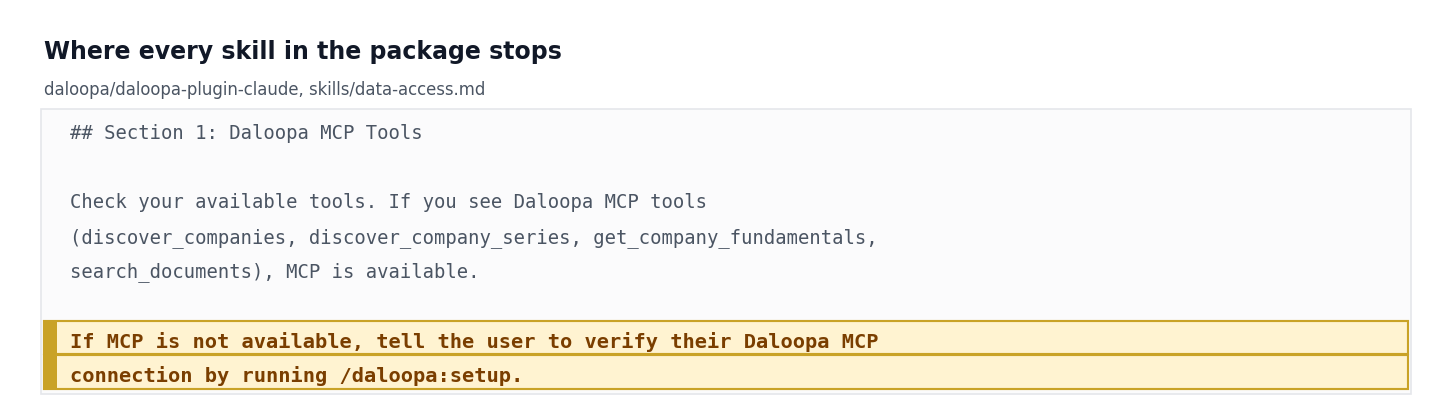
Every skill in the Daloopa package goes through five vendor tools. When they're missing, the instruction is to tell the user to reconnect. No free path exists in that package, and none was meant to.
Anthropic's side needs a distinction, because the two halves behave differently. dcf-model is data agnostic: it reads SEC filings, uses web search for prices and beta, and works with whatever MCP servers happen to be connected. Anyone can run it today, no subscription.
Verticals are the other story. Claude for Financial Services routes through eleven connectors, Daloopa and FactSet and S&P Global and Moody's and LSEG and PitchBook and Morningstar among them, and Anthropic's own documentation says access "may require a separate subscription or API key from the respective provider."
So the gate is real. It sits at the data layer, not inside every skill, and saying otherwise would be easy to disprove.
Why "by design" is the right phrase
Three limits fall out of what a shared package has to be, and shipping more versions won't fix any of them.
A vendor's skill routes to that vendor. Daloopa's skills exist so Daloopa data gets used, and report attribution defaults to their name. Wanting a free fallback inside them means wanting a company to undercut its own product, which isn't a criticism so much as a description of how it works.
Then there's method. A skill written for every subscriber has to strip out the judgment that separates one research process from another. Your premium source, how you build beta, what you do with leases and buybacks and stock comp, all of it collapses into somebody's midpoint. Equity research gets differentiated by exactly the thing a general package must remove.
Last, defaults go invisible the moment they ship. A number picked as a sensible starting point ends up in every output, unsurfaced, undated, unrevisited. Nothing in the skill format nudges anyone to write "premium was 5.5%, sourced on this date, from this calculation." Convenience quietly hardens into method.
None of that makes these packages bad. It's what a general purpose package has to be.
Building one is smaller than it sounds
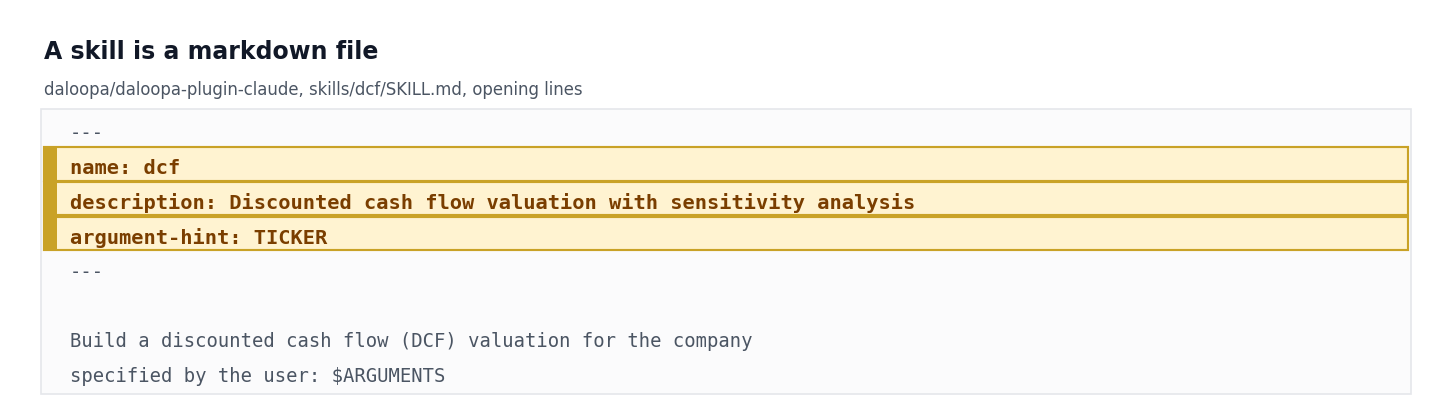
That's the whole format. Name, description, an argument hint, then instructions in English. Every excerpt in this article came straight off GitHub as ordinary markdown, readable in a browser.
Which means engineering was never the barrier. Knowing what a bottom-up beta is, and why it beats a five-year regression for a company that refinanced last year, that's the barrier.
Every DCF input has a free source.
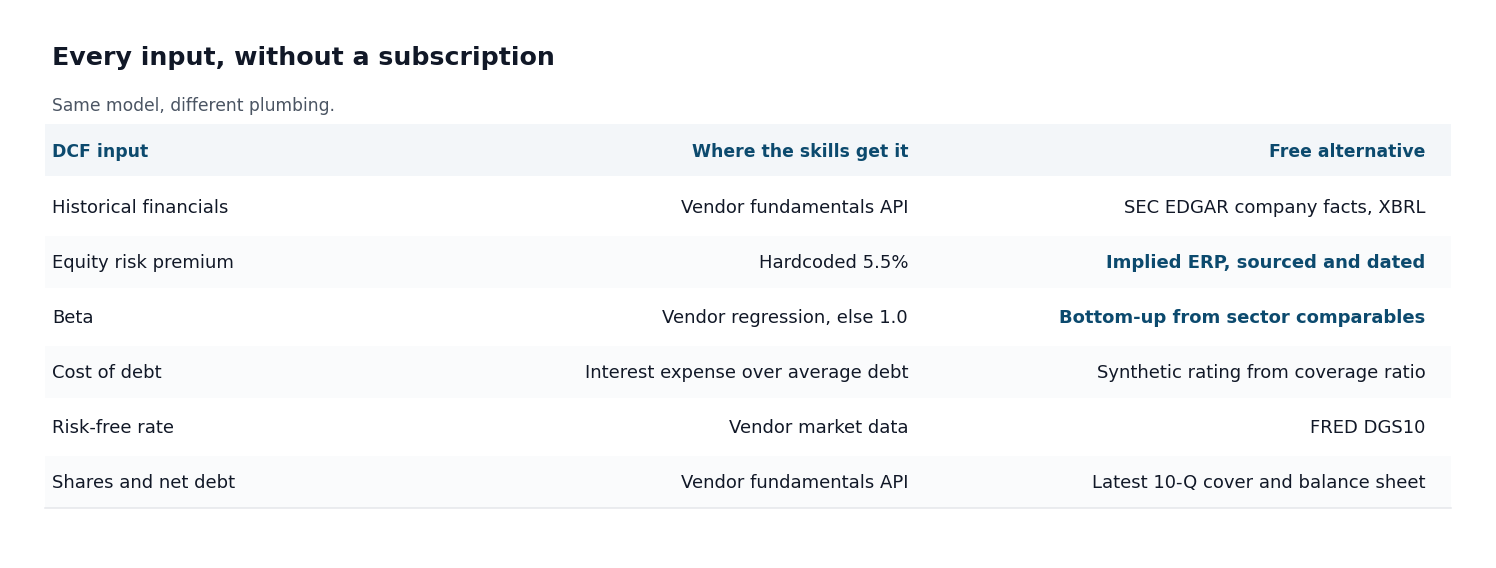
EDGAR has the filings, same place the vendors get them, and its companyfacts endpoint hands back structured XBRL for any filer. FRED has the risk-free rate. Implied premium comes out of index level, aggregate cash flows and the ten-year yield, and can carry the date it was computed. Beta gets rebuilt from unlevered sector comparables and relevered at the target's own capital structure. Cost of debt comes off a synthetic rating from interest coverage, rather than dividing last year's interest expense by average debt.
Different plumbing, same model, and an answer somebody can audit line by line.
Fork it, don't start from a blank page
Nothing above argues for starting over. Beginning from one of these packages is faster and lands better, because years of process are already written down inside them.
Licensing allows more than most people assume.
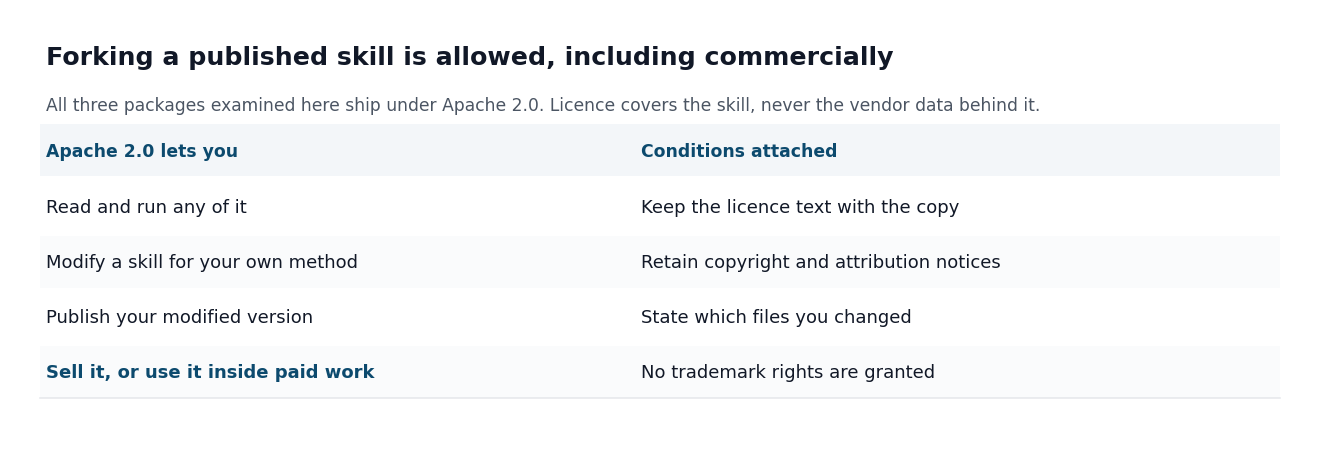
All three packages here ship under Apache 2.0. Forking, modifying, republishing, selling, all permitted. Conditions are light: keep the licence text, leave attribution notices alone, say which files you changed. Trademarks are excluded, so a fork can't imply endorsement or take the original name.
One boundary matters. Licence covers the skill, meaning the instructions and any scripts. Data behind it runs on the vendor's own terms, a separate agreement. Forking Daloopa's DCF gets you their method and none of their fundamentals.
So read the DCF skill end to end, which takes about twenty minutes since it's plain English. Keep the craft: sector KPI taxonomy, the terminal value flag at 80%, formulas over hardcodes, the stage-by-stage confirmation, the odd-numbered grid whose centre cell has to reproduce the base case. Reinventing that would take months.
Then rip out the plumbing. Every input somebody else already decided for you, starting with the premium.
And add the part neither package has, where the skill prints the source and date of every assumption it used. Nothing prevents it. Once one skill does it, going back feels careless.
What replacing the plumbing looks like
Worth making concrete, so here's one built that way.
equity-research-agents splits a DCF framework across two agents that are not allowed to read each other. Architect owns the generator, the schema and the 10-K facts, and is banned from expressing any view, including in its own notes. Analyst owns the scenarios and the write-up, and is forbidden from reading anything the architect produced, so the model's implied price never becomes a target to reverse-engineer toward.
Premium in that framework is a sourced input, not a constant. Base case has to equal Damodaran's current published value exactly, bull sits 25 to 75bps below it as a franchise-quality discount, bear 50 to 125bps above for cycle and regulatory risk. Same number, turned from an assumption into a scenario lever with a citation attached.
Rest of it is the same pattern applied elsewhere. Gross margin never held flat, five research buckets mandatory. Base case built first, bull and bear derived by perturbation. Driver attribution in basis points with a source per variable. Three retunes maximum, and retuning to silence a warning named as the thing not to do.
Repository holds the agent definitions and the written method. Generator stays private, which is the point: the method is the part worth publishing.
Skills are cheap to write. Your method isn't, and that's the part nobody can hand you.
Skill excerpts come from daloopa/daloopa-plugin-claude and Mesitis/financial-services-plugins, both public, read September 2026. Sensitivity chart is illustrative and built on the assumptions printed on it. Nothing here is investment advice.
 Watch my latest video
How AI companies tricked you with Claude skills for finance
What Claude for Financial Services really ships, and the hardcoded numbers inside its DCF skill.
Watch my latest video
How AI companies tricked you with Claude skills for finance
What Claude for Financial Services really ships, and the hardcoded numbers inside its DCF skill.

Written by David Arias, CFA
CFA charterholder and licensed portfolio manager working on emerging markets private debt, derivatives and quantitative finance. Builds open-source AI tools for finance, like Glassbench, and publishes the code behind every model on this site.
See more from me