New DeepSeek model competes with Claude and GPT-6.1 while costing 90% less: a “deep” analysis
DeepSeek V4.1 Flash 1017 reports 77% on DeepSWE for about $0.20 a task. Independent boards put it 14th of 50 on the Vals Index and 17th of 80 on finance, ahead of GPT-6.1 Sol, at $1.20 per million output tokens against $10.
Vals IndexFinance Agent v2DeepSeek releaseGlassbench (GitHub)
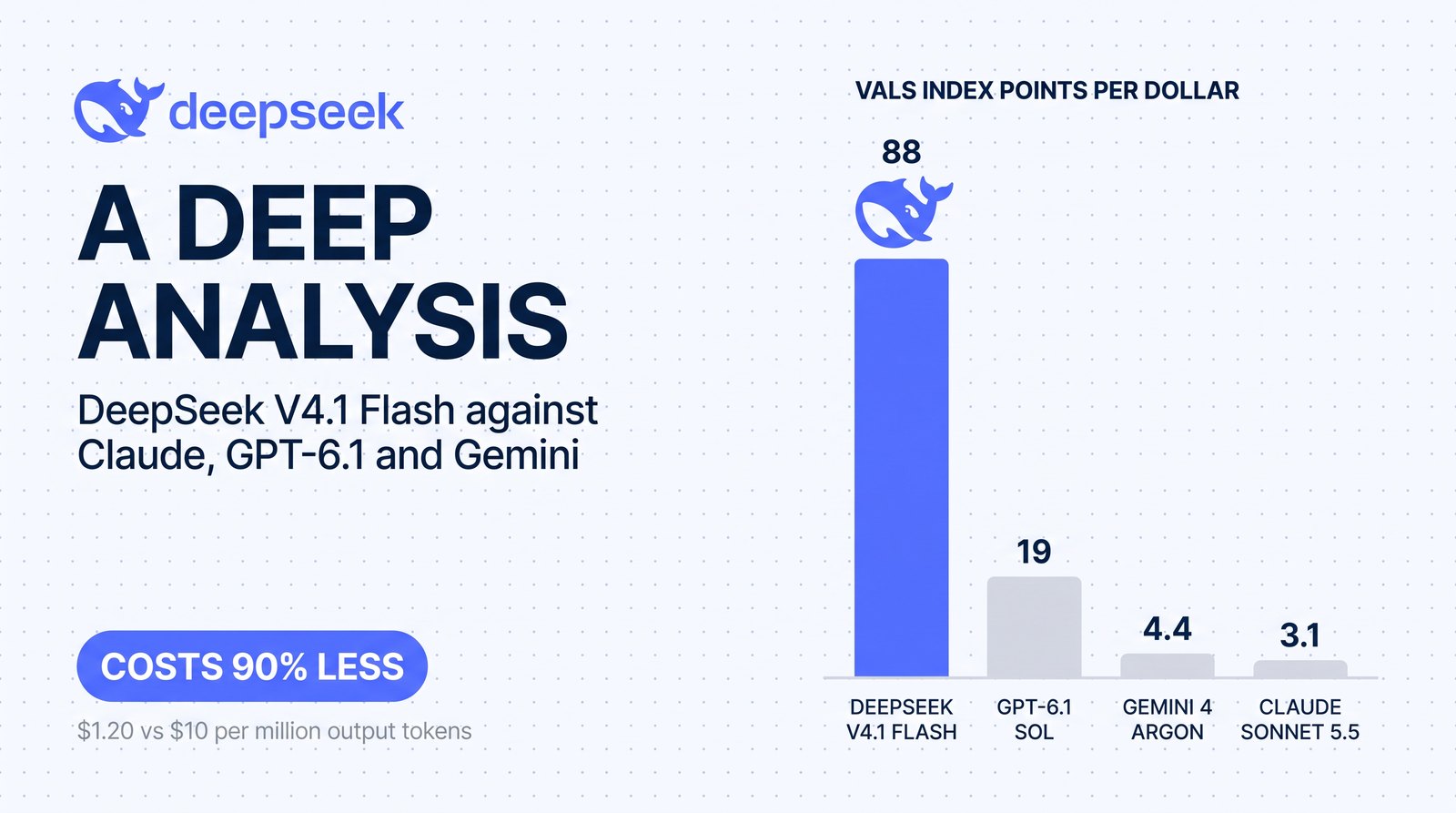
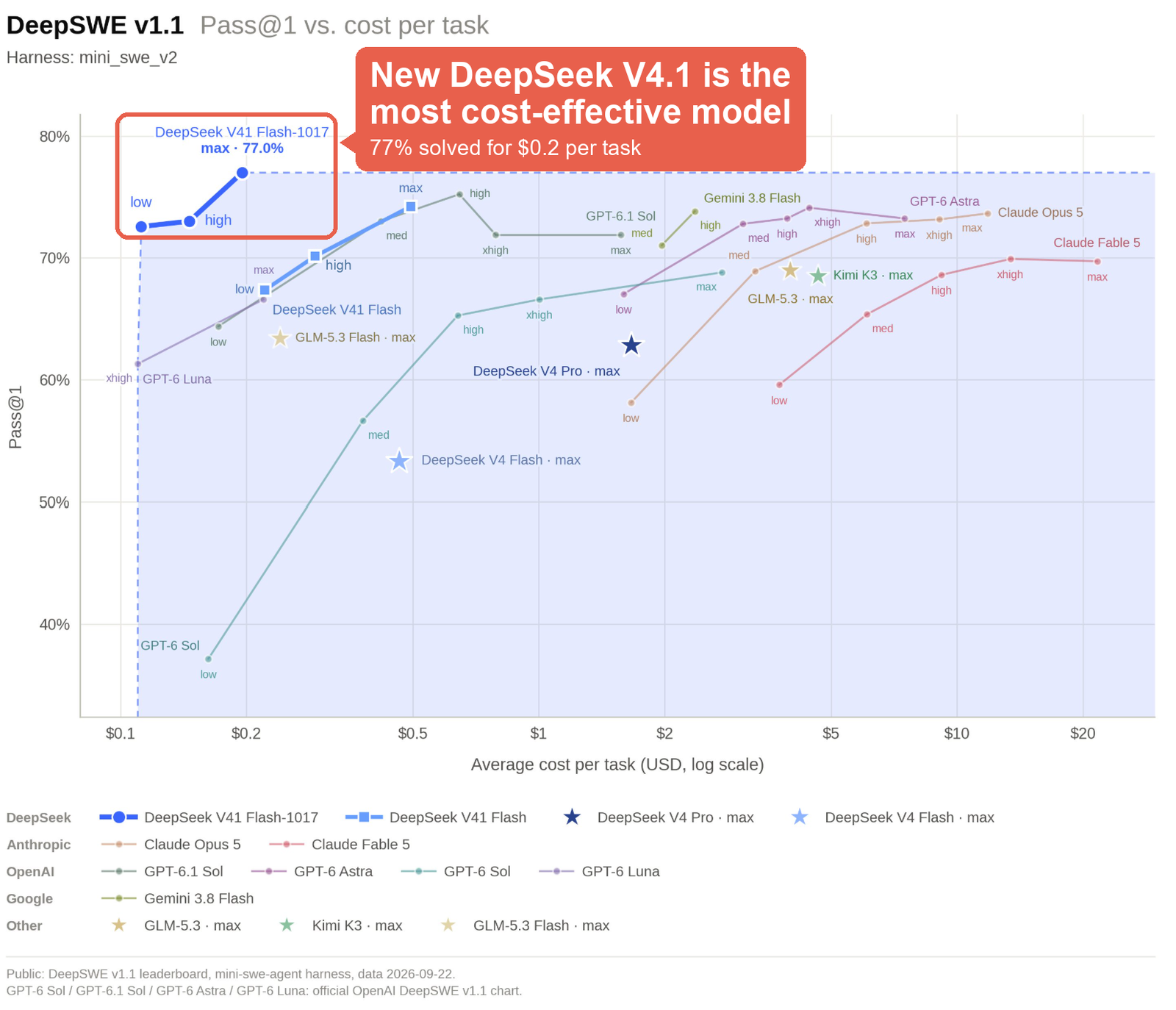
DeepSeek released V4.1 Flash 1017 on 17 October, an update to its September Flash model at the same list price: $0.30 per million input tokens and $1.20 per million output tokens. Claude Sonnet 5.5 and GPT-6.1 Sol both charge $10 per million output tokens. In DeepSeek's own run, the new model solves 77.0% of DeepSWE v1.1, a benchmark of real software engineering tasks, for about $0.20 a task. On the public DeepSWE board, the best result is 74.1% from GPT-6 Astra at $4.43 a task, and Claude Opus 5 solves 73.6% for $11.84.
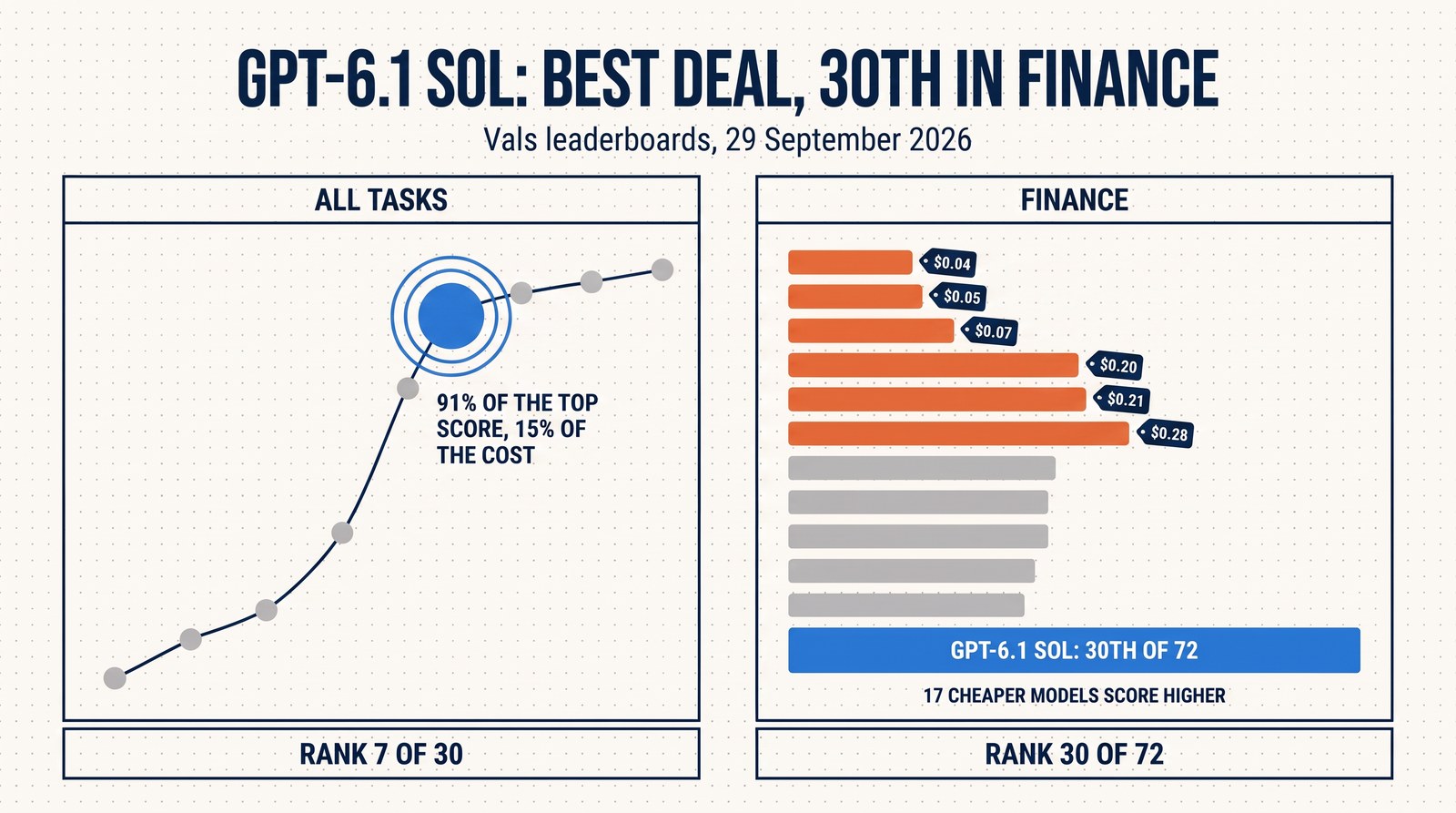
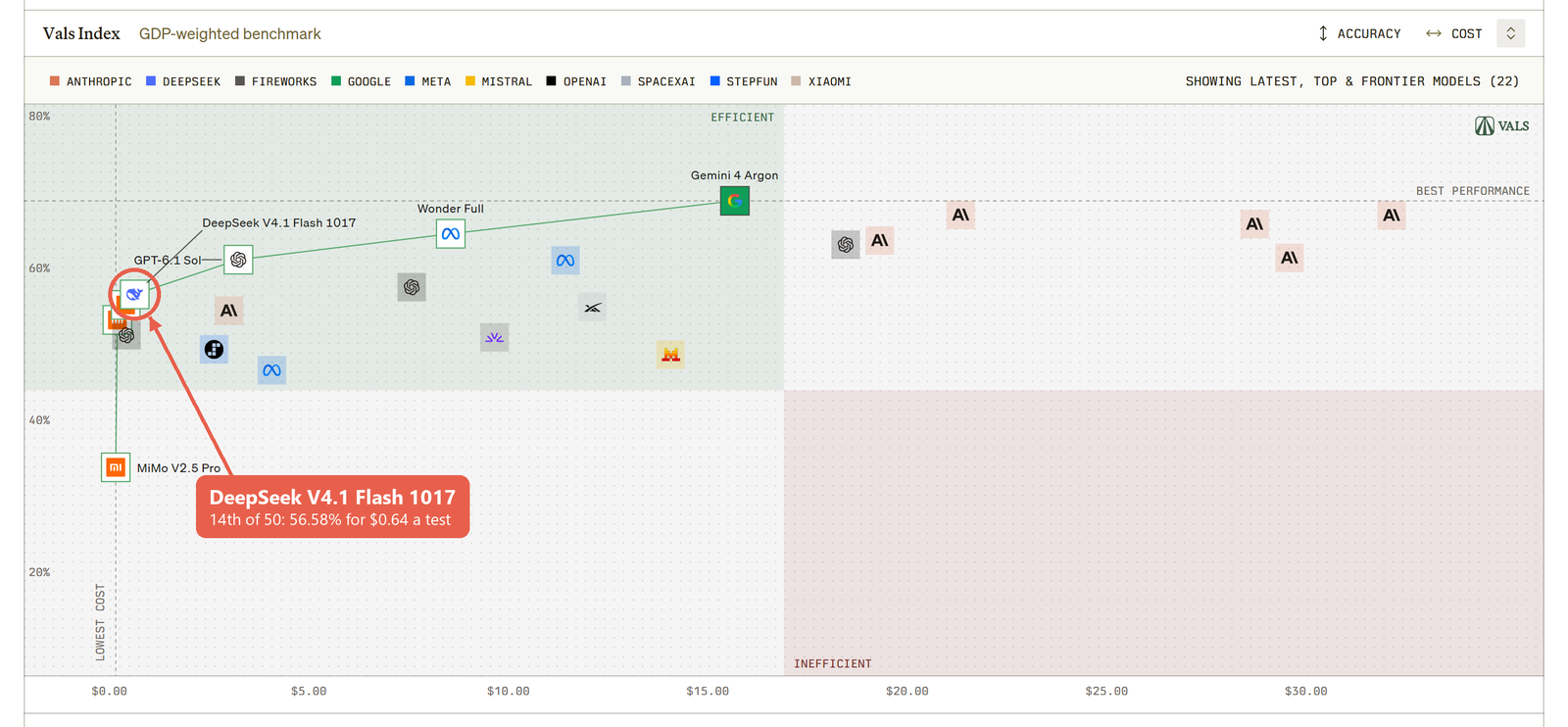
Independent boards updated since the release show a strong model at a low price, one notch below that headline. Flash 1017 ranks 14th of 50 on the Vals Index for $0.64 a test, 4% of what the leader costs. On Vals's finance agent benchmark it ranks 17th of 80, ahead of GPT-6.1 Sol and 1.1 points behind Claude Sonnet 5.5, at one fourteenth of Sonnet's cost. Artificial Analysis puts it second among open-weights models, and it's the fastest of the ten models on that site's headline charts.
Already tested on DeepSeek: the systems where it has run, each filmed from install to the first decision.
What DeepSeek serves today
DeepSeek sells two models through its API. Flash is the cheap, fast line and got the October update. Pro is the large model, still on its August snapshot; DeepSeek hasn't shipped a V4.1 Pro.
| V4.1 Flash 1017 | V4 Pro 0813 | |
|---|---|---|
| API name | deepseek-flash | deepseek-v4-pro |
| Released | 17 Oct 2026 | 13 Aug 2026 |
| Parameters | 552B, 8B to 16B active | 1.6T, 49B active |
| Context window | 1M tokens | 1M tokens |
| Input, per 1M tokens | $0.30 ($0.006 cached) | $1.32 ($0.044 cached) |
| Output, per 1M tokens | $1.20 | $3.96 |
| Licence | MIT, weights on Hugging Face | MIT, weights on Hugging Face |
Those are peak prices. Outside peak hours DeepSeek charges half. Both models are open weights under MIT, so the same model can run on private hardware, which matters to any firm that can't send client data to an outside API.
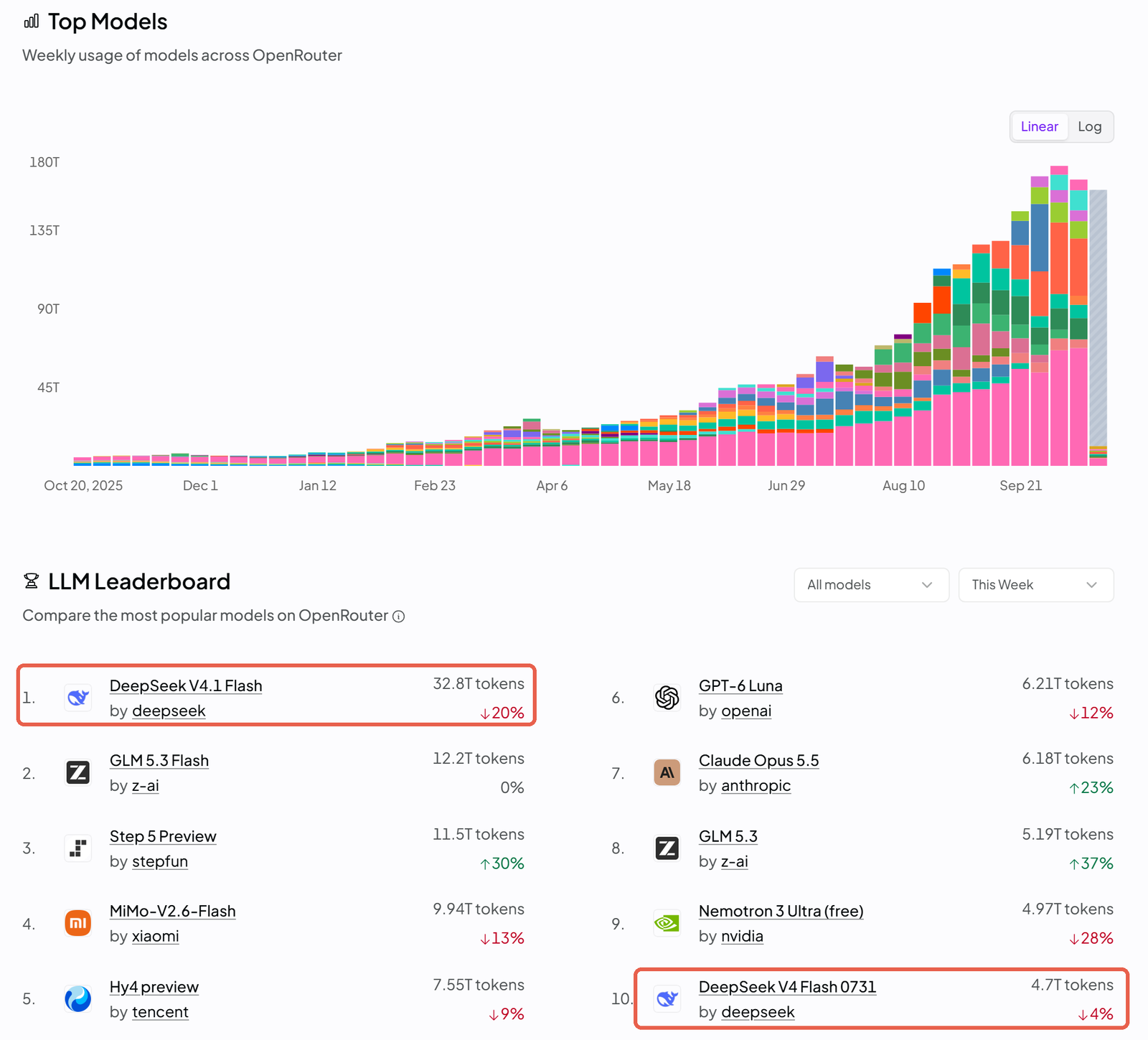
Developers have already voted with their tokens. On OpenRouter, the September Flash was the most used model of the week starting 12 October, with 32.8 trillion tokens, and DeepSeek was the top author with 24.4% of all text requests.
Coding: the 77% is DeepSeek's own number
DeepSWE scores how often a model, run inside the same simple agent, fixes a real software issue on the first try. Here is the release chart next to the public board:
| Model, effort | Solved | Cost per task | Source |
|---|---|---|---|
| DeepSeek V4.1 Flash 1017, max | 77.0% | about $0.20 | DeepSeek release |
| DeepSeek V4.1 Flash 1017, low | about 72.5% | about $0.11 | DeepSeek chart, read off the image |
| DeepSeek V4.1 Flash (Sep), max | 74.2% | about $0.50 | DeepSeek release |
| GPT-6 Astra, xhigh | 74.1% | $4.43 | public board |
| Gemini 3.8 Flash, high | 73.8% | $2.36 | public board |
| Claude Opus 5, max | 73.6% | $11.84 | public board |
| GLM-5.3, max | 69.0% | $3.99 | public board |
| DeepSeek V4 Pro, max | 62.8% | $1.67 | public board |
Datacurve's public board was last updated on 22 September and has no V4.1 Flash yet. Where it does list DeepSeek models, DeepSeek's own figures land close to it: 62.7% against the board's 62.8% for V4 Pro, 54.4% against 53.3% for V4 Flash. That's a decent sign for the 77%, and it stays a vendor number until the board reruns it.
Independent coding tests come in lower. On Terminal-Bench 4.0, where a model works inside a live terminal, DeepSeek reports 42.3. Artificial Analysis measured 33.8 and Vals 31.82%, 17th of 50, at $0.54 a test, against Claude Opus 5.5's 65.15% at $13.20. On Vals's Vibe Code Bench, Flash 1017 scores 87.73%, 11th of 114, for $0.58 a test. Claude Sonnet 5.5 leads with 92.39% at $31.25.
Across all tasks: 14th of 50 for 4% of the cost
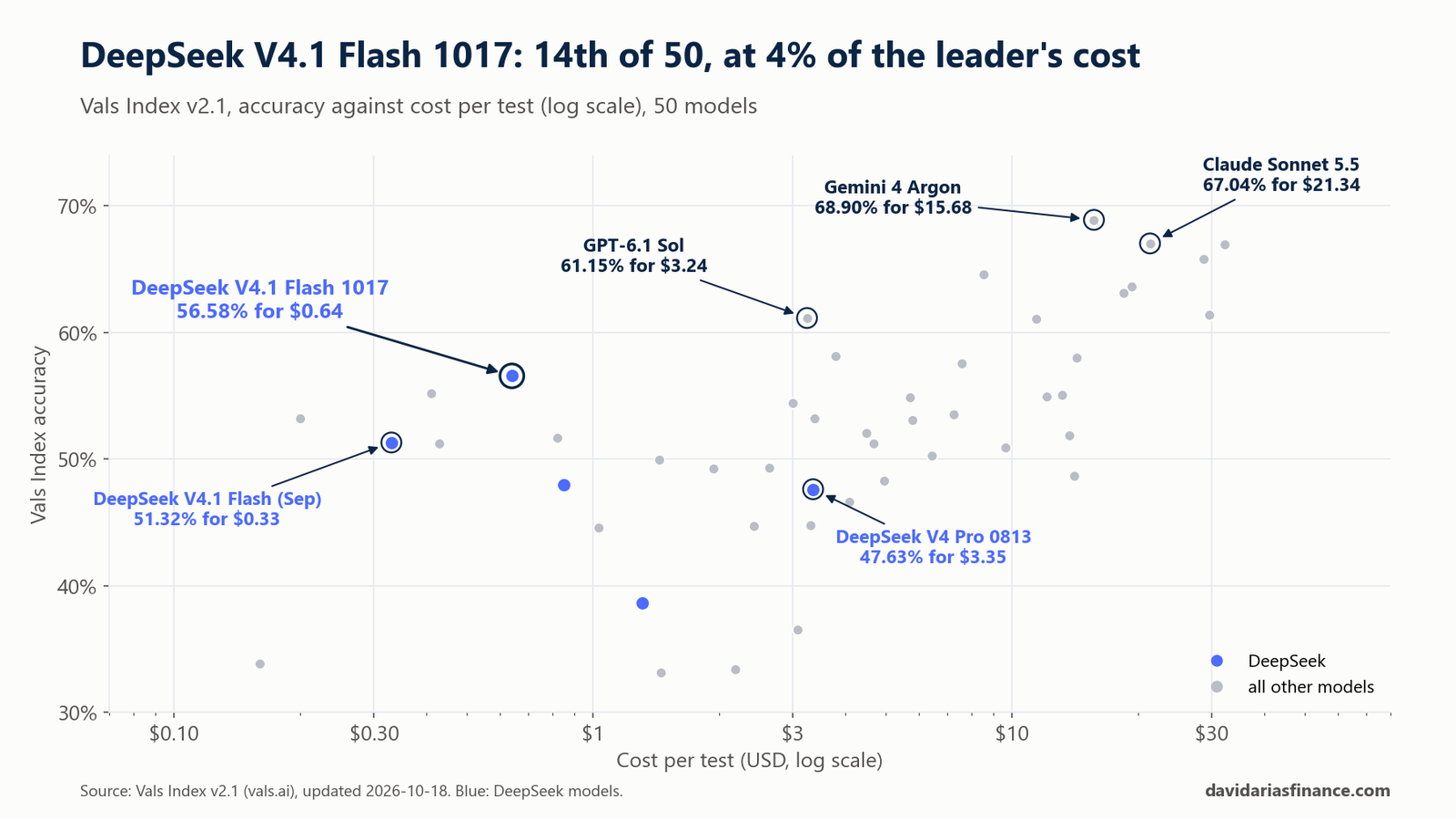
Vals weights its index by the economic value of the work: finance, law, tax and coding tasks. Flash 1017 scores 56.58% at $0.64 a test. Gemini 4 Argon leads with 68.90% at $15.68, 24.5 times the cost for 12.3 more points. Measured as cost per point of accuracy:
| Model | Vals Index | Cost per test | Cost per point |
|---|---|---|---|
| Gemini 4 Argon | 68.90% | $15.68 | $0.228 |
| Claude Sonnet 5.5 | 67.04% | $21.34 | $0.318 |
| GPT-6.1 Sol | 61.15% | $3.24 | $0.053 |
| DeepSeek V4.1 Flash 1017 | 56.58% | $0.64 | $0.011 |
| MiMo V2.6 Pro (Xiaomi) | 55.20% | $0.41 | $0.007 |
| DeepSeek V4.1 Flash (Sep) | 51.32% | $0.33 | $0.006 |
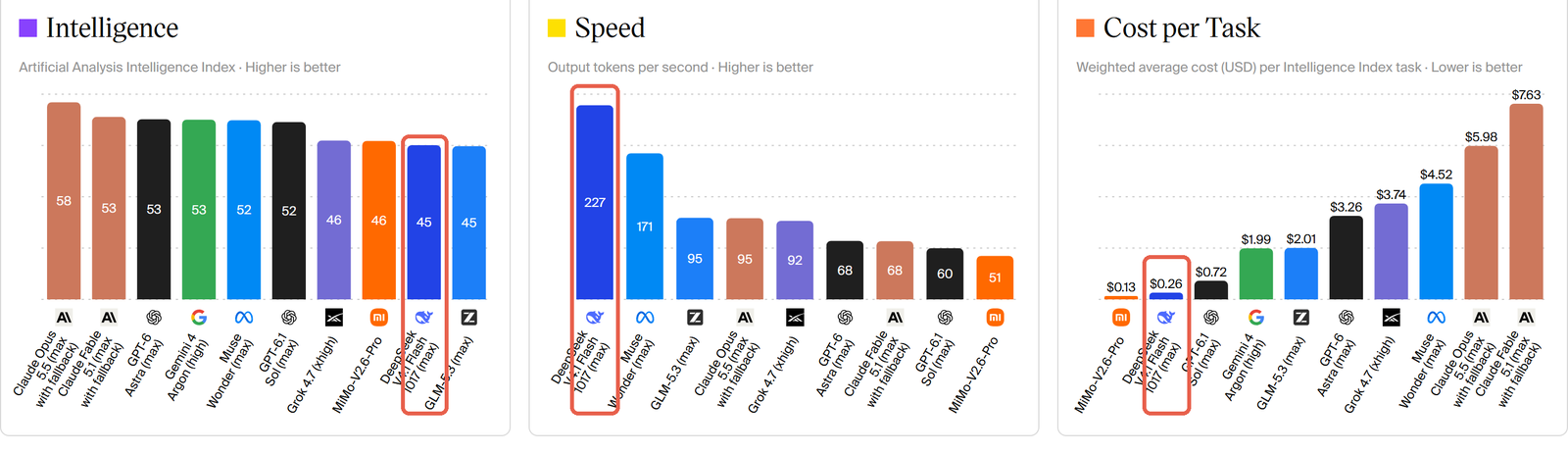
One oddity: on Vals, Flash 1017 costs twice as much per test as the September Flash, because it wrote 316.64 million output tokens over the run against 138.82 million. It thinks longer. On Artificial Analysis the order flips, $0.26 a task against $0.49. Price per token is identical, so the bill depends on how long the model reasons on each kind of task.
Artificial Analysis runs its own ten evaluations. Flash 1017 at max effort scores 45.1, second among open-weights models behind Xiaomi's MiMo-V2.6-Pro at 46.3, for $0.26 a task. Claude Opus 5.5 leads at 57.6 for $5.98 a task, and GPT-6.1 Sol scores 51.8 for $0.72. Flash 1017 also writes 227 tokens a second.
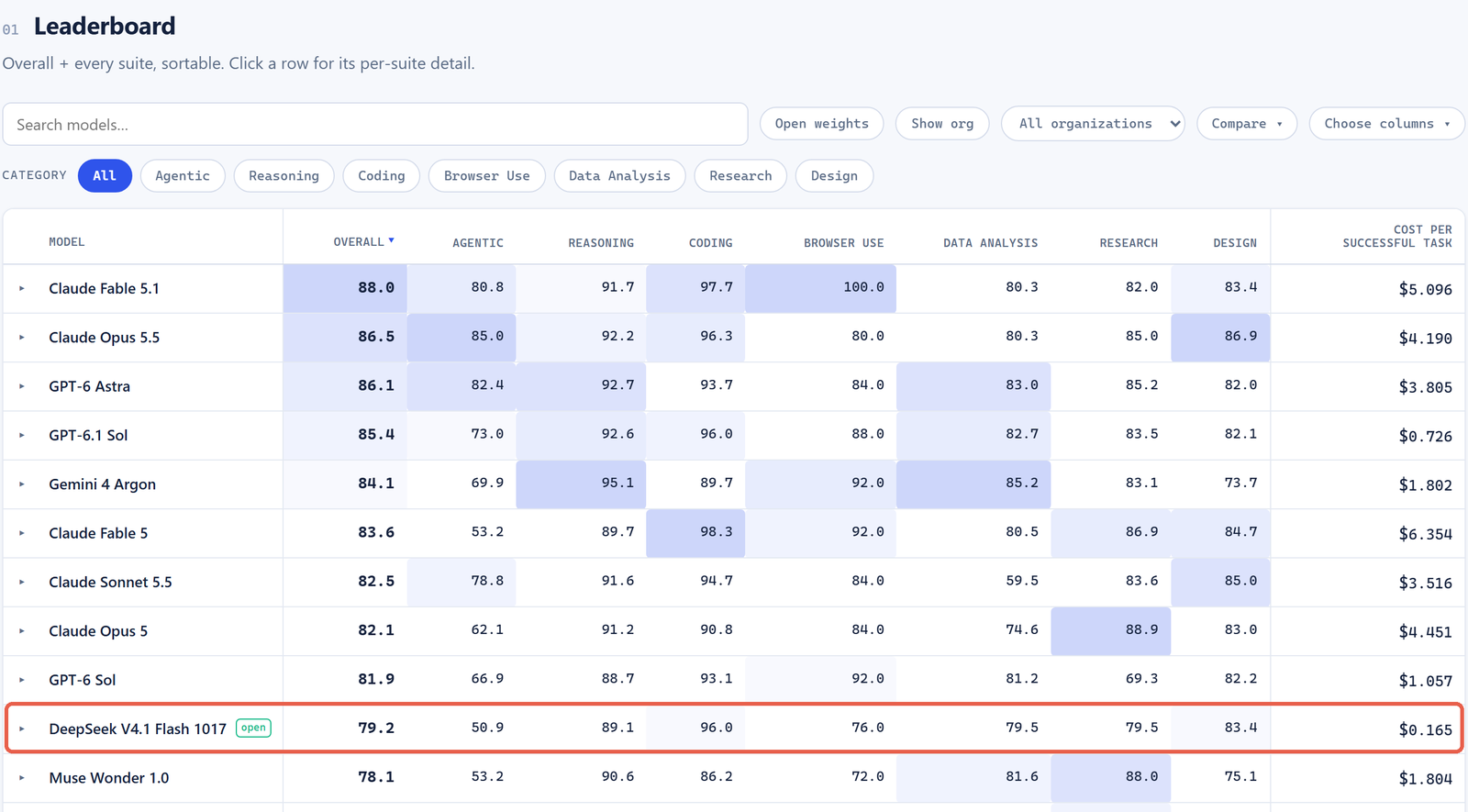
LiveBench, a contamination-free benchmark that hands models real work, put Flash 1017 10th of 48 on 18 October with 79.2, the highest open-weights row, at $0.165 per successful task. GPT-6.1 Sol scores 85.4 at $0.726 and Claude Opus 5.5 86.5 at $4.19. LMArena's crowd vote hasn't added Flash 1017 yet. Its September predecessor sits 38th of 416 with 1475 points, the same score as Claude Sonnet 5.5 at 36th.
On finance: 17th of 80, ahead of GPT-6.1 Sol
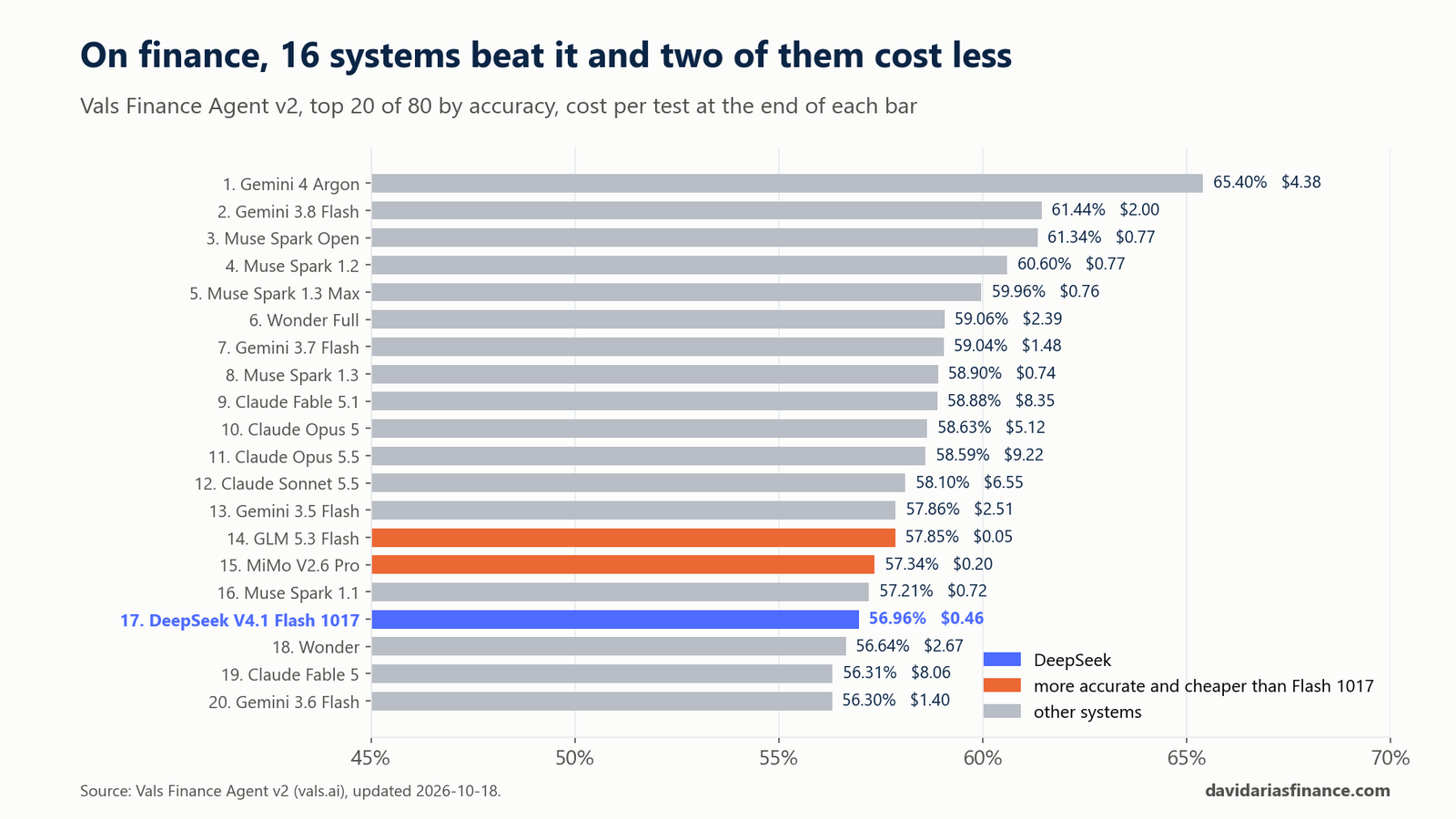
Finance Agent v2 is Vals's benchmark of core financial analyst tasks: reading filings, building comparables, analysing earnings. Flash 1017 scores 56.96% for $0.46 a test, up from 53.48% and 34th place for the September model. It beats GPT-6.1 Sol (52.03% at $1.62) and sits 1.14 points behind Claude Sonnet 5.5 (58.10% at $6.55) and 1.63 behind Claude Opus 5.5 (58.59% at $9.22). Gemini 4 Argon leads with 65.40% for $4.38.
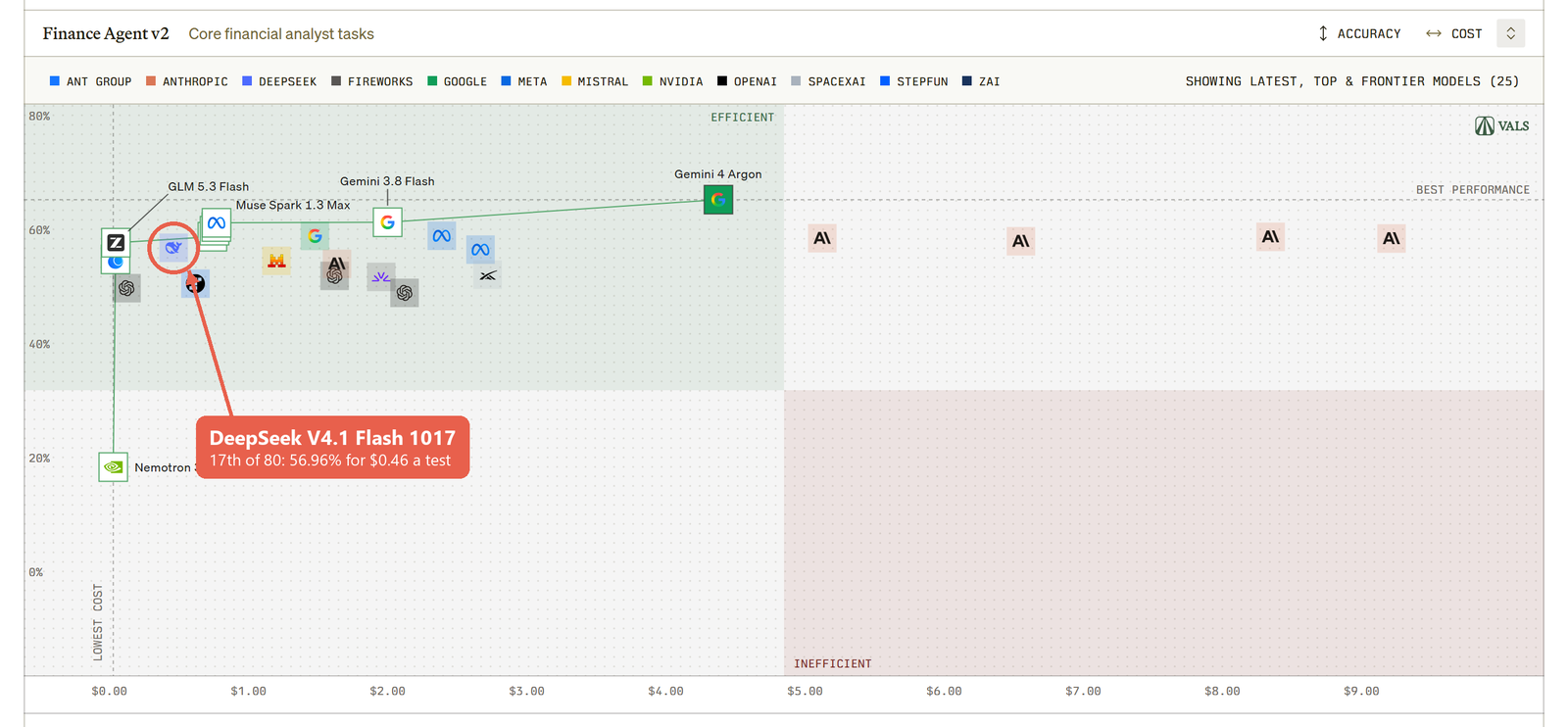
Two cheaper systems do better on finance, which is why Flash 1017 sits just under the frontier here: Z.ai's GLM 5.3 Flash scores 57.85% for $0.05 a test and Xiaomi's MiMo V2.6 Pro 57.34% for $0.20. On Vals's Tax Agent Bench, Flash 1017 ranks 5th of 71 with 44.35% for $0.46, against 49.19% for Claude Fable 5.1 at $13.18. CorpFin v2 and TaxEval v2 haven't been rerun since V4.1 shipped. Their best DeepSeek entry is still V4 Pro 0813, 29th of 134 on CorpFin with 65.42%.
What DeepSeek reports and what others measure
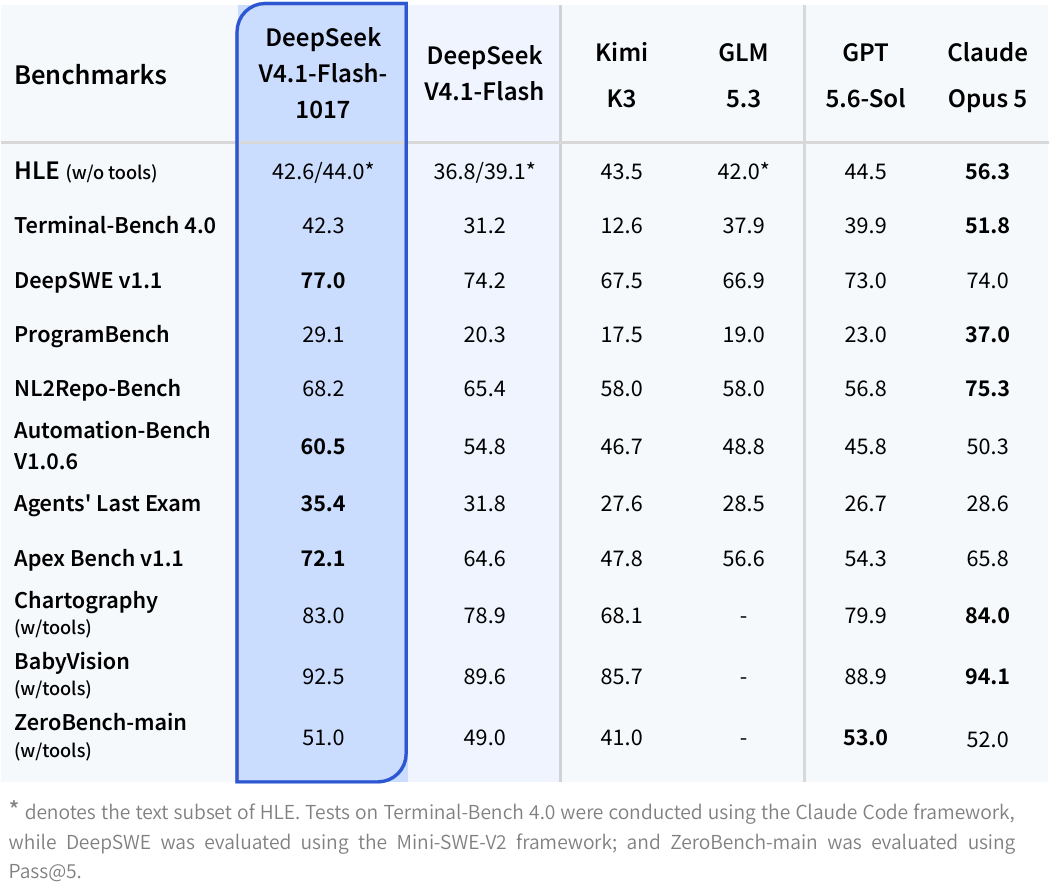
Where the same test has both a DeepSeek number and an outside one, they line up like this:
| Benchmark | Model | DeepSeek reports | Measured outside | By |
|---|---|---|---|---|
| GPQA Diamond | V4.1 Flash | 90.9 | 89.8 | Epoch AI |
| SWE-bench Verified | V4 Pro (April) | 80.6 | 77.6 | Epoch AI |
| Terminal-Bench 4.0 | V4.1 Flash 1017 | 42.3 | 33.8 and 31.8 | Artificial Analysis, Vals |
| Terminal-Bench 2.1 | V4.1 Flash | 90.6 | 74.5 | Vals |
| DeepSWE v1.1 | V4.1 Flash 1017 | 77.0 | not run yet | Datacurve board |
GPQA and SWE-bench Verified agree within about three points. Terminal-Bench differs by 8 to 16 points, and most of that gap is the harness: DeepSeek ran Terminal-Bench 4.0 inside Claude Code and 2.1 inside its own harness, while Vals uses a plain reference agent for every model. A release table shows a ceiling. Independent boards show what a standard setup gets.
Glassbench and the new Search API
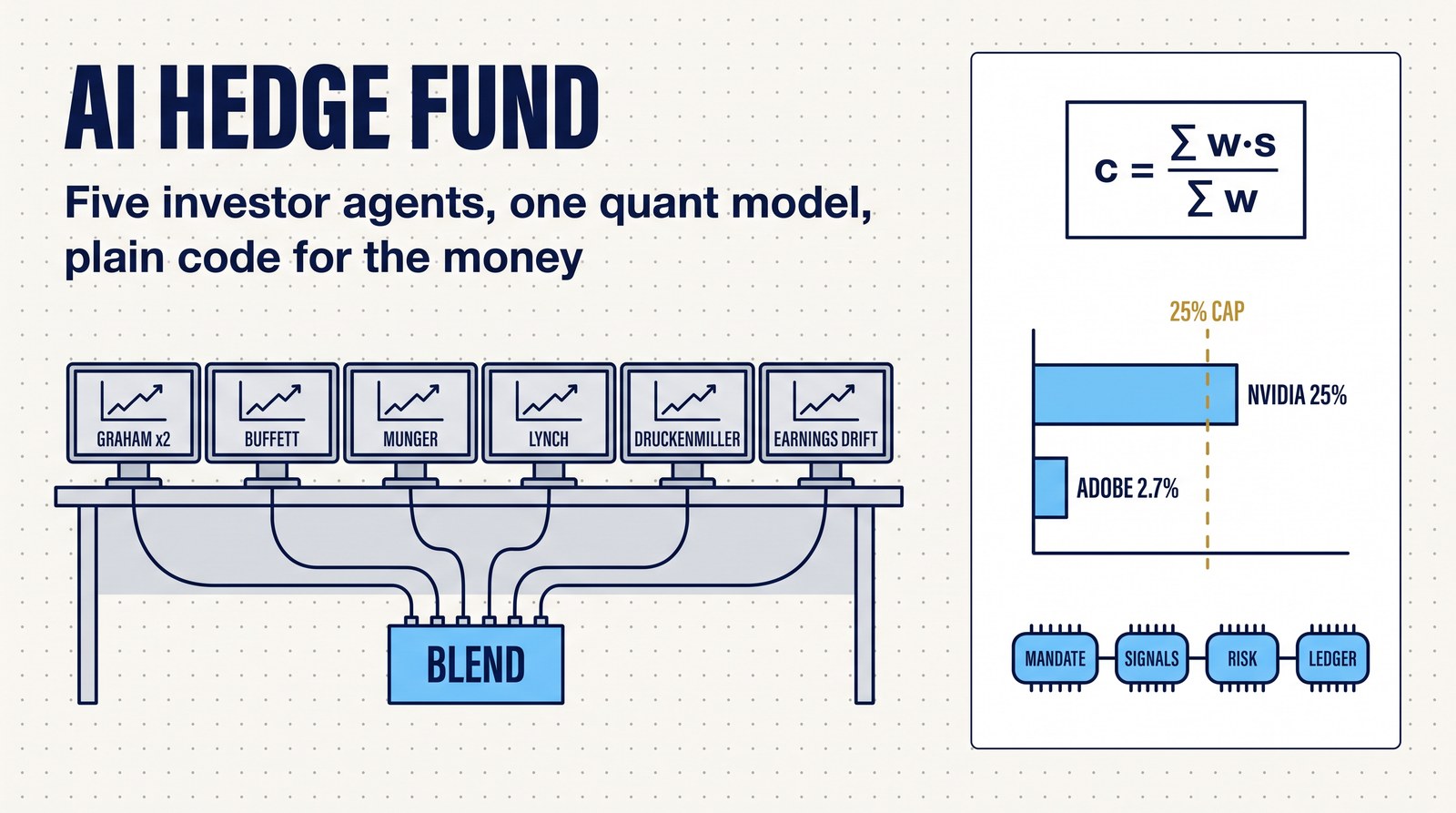
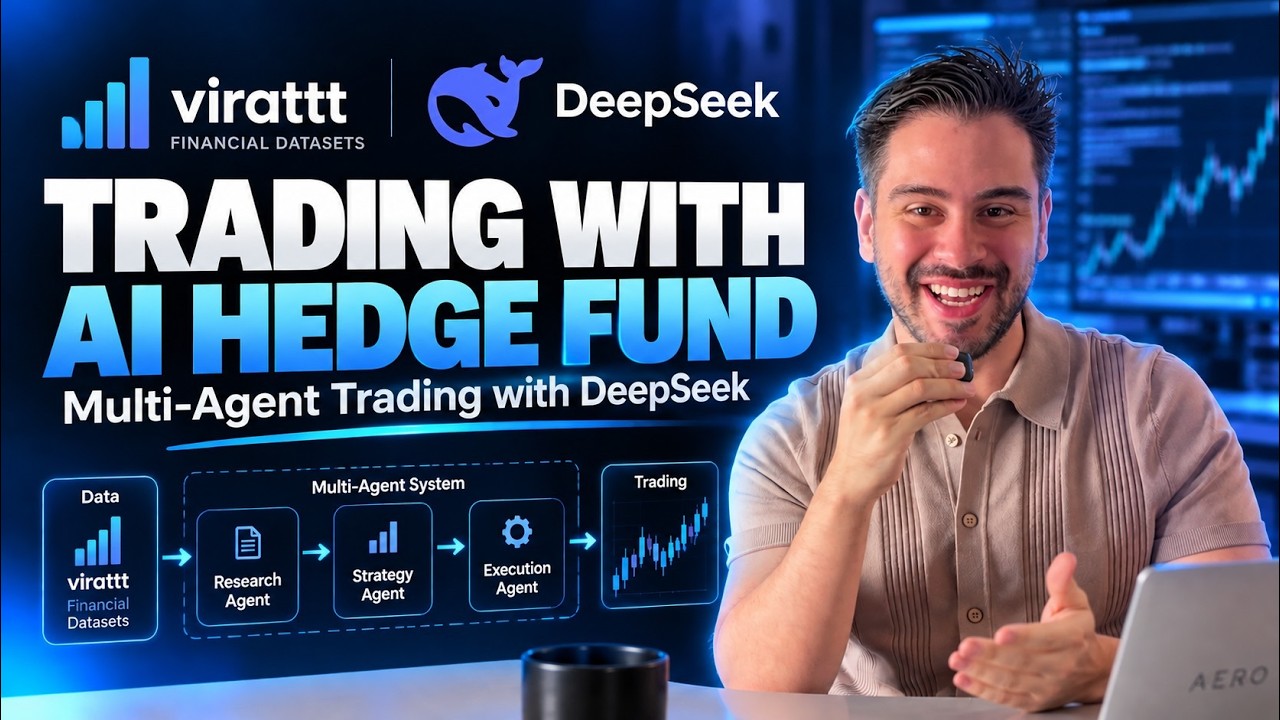
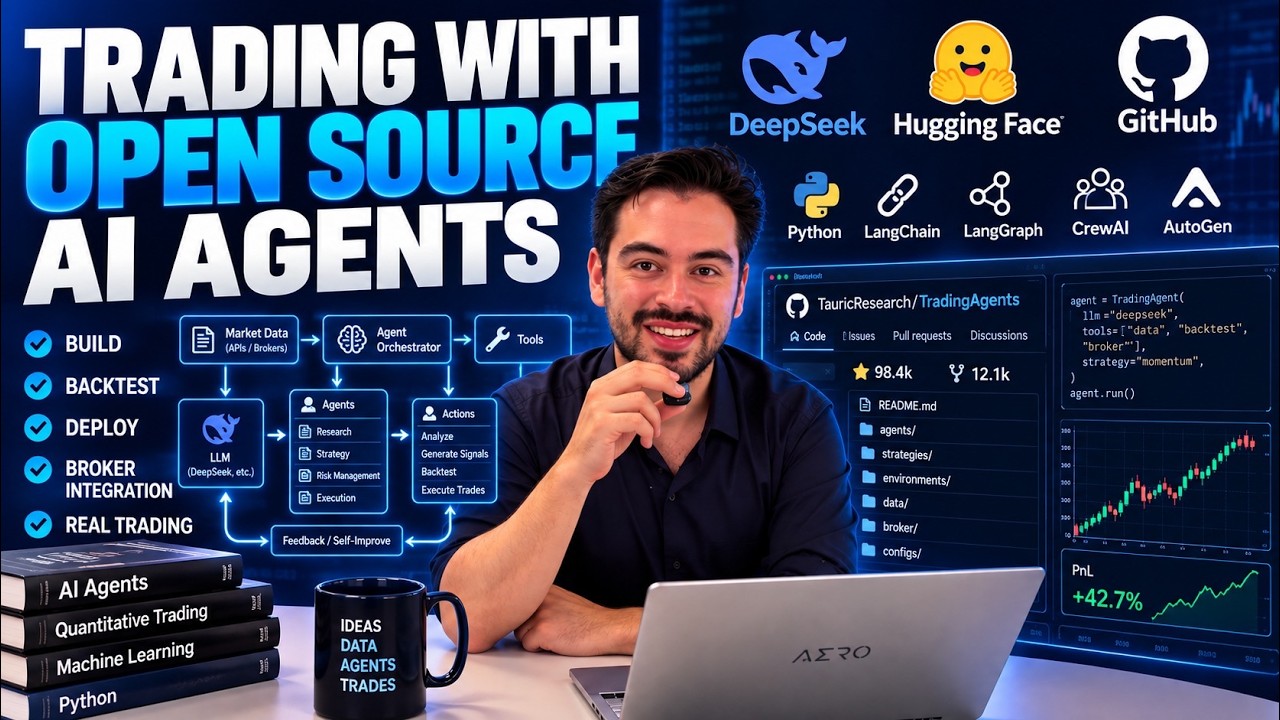
Both systems in the videos at the top of this page run in Glassbench, an open-source workbench that puts TradingAgents and AI Hedge Fund on the same stock and date and records what every agent read, argued and decided. In both, DeepSeek does the reading and the arguing. A full TradingAgents committee, twelve agents and about 19 model calls with Flash for the analysts and Pro for the two managers, costs about six cents, and Glassbench's database holds 100 runs, all on DeepSeek.
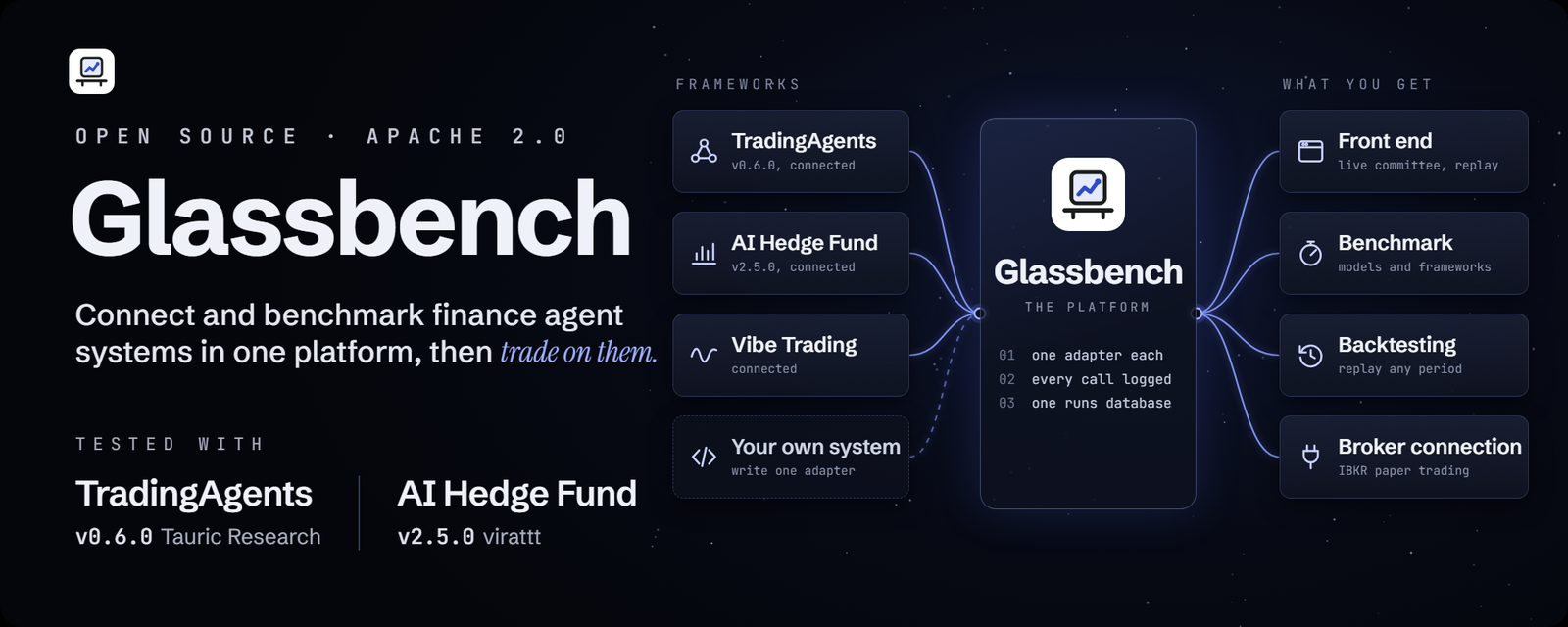
Its weak spot has been news: Yahoo Finance serves no articles for a past date, so a backtest's news analyst reads nothing. DeepSeek's Search API, released the same day as Flash 1017, closes that gap for $0.75 per 1,000 searches, on the same API key, with date operators (after:, before:) and site: filters, in under a second a call. A news variant being added to Glassbench routes both news tools through it, bounded to the run's window. On an NVIDIA run dated 12 October, 11 searches returned 103 results. After dropping rolling news pages and any text that names a later date, 52 articles dated on or before 11 October reached the news analyst, for less than one cent. Searches made through DeepSeek's own harness, Claude Code or Codex are free until 1 November.
Sources: Vals AI leaderboards (Vals Index v2.1, Finance Agent v2, Tax Agent Bench, Terminal-Bench 4.0, Vibe Code Bench) updated 18 October 2026, CorpFin v2 12 August; Artificial Analysis Intelligence Index v4.3.2, 19 October; LiveBench 2.0, 18 October; LMArena text, 15 October; EMB, Harvey's Legal Agent Benchmark and Code Migration on Vals, 18 October; Epoch AI benchmark data; Datacurve DeepSWE v1.1 board, 22 September; OpenRouter rankings through 18 October; DeepSeek's model cards on Hugging Face, API pricing page and 17 October release notes. Points on DeepSeek's DeepSWE chart other than the labelled 77.0% were read off the image, calibrated on the 22 points that also appear on the public board (error under 0.3% on cost). Every number was saved with its page on 19 October 2026.

Written by David Arias, CFA
CFA charterholder and licensed portfolio manager working on emerging markets private debt, derivatives and quantitative finance. Builds open-source AI tools for finance, like Glassbench, and publishes the code behind every model on this site.
See more from me