
A graduate course archive at NYU, a 317 page practitioner book given away by its author, two Python channels, MIT 18.S096, and one Goldman Sachs paper from 1999 that still explains variance swaps better than anything written since.
Volatility material tends to arrive in two flavours. Priced like a terminal subscription, or written for somebody who already knows the answer. Six things escape that, and every one of them was opened and checked on 31 August 2026.
Free here means free. No trial, no audit track that quietly withholds the problem sets, no email wall in front of the PDF. Each link below goes straight to material a reader can use the same afternoon.
Order runs from broadest to most specific. Avellaneda's archive is close to a full graduate sequence in derivatives, still sitting on a university server. Goldman's variance swaps note is 56 pages that finish one instrument completely. Everything else falls somewhere along that line.
| Resource | Format | Size | Best for |
|---|---|---|---|
| Avellaneda, NYU | Slides, notes, data | 5 courses | Coursework with the assignments |
| QuantPy | Video, Python | 96,300 subs | Building the model yourself |
| Bennett, Trading Volatility | PDF book | 317 pages | Desk reference on skew |
| quantpie | Video, derivations | 24,500 subs | Following the algebra |
| MIT 18.S096 | Video, notes, sets | 24 lectures | Structured self study |
| Goldman variance swaps | PDF paper | 56 pages | Understanding VIX and vol swaps |
Sizes above are counts, so read them as scope and nothing else. A 24 lecture course and a 56 page paper are aimed at completely different afternoons.
Ninety four firm characteristics feed a neural network with three hidden layers, trained on expanding windows so that validation never sees the future. Predictions rank every stock, then the top decile is bought and the bottom decile sold. Model selection runs on the information coefficient rather than mean squared error, which holds up better on limited data. Method comes from Gu, Kelly and Xiu (2020), Empirical Asset Pricing via Machine Learning, rebuilt here on free data instead of the 30,000 stocks and 920 features of the original. Last step connects the book to the Interactive Brokers API through a Python script, so the strategy places its own long short orders rather than printing a backtest. Code and notebook are on GitHub.
I post the models as I build them, the changes I make to them, and the results that did not work. Shorter than these write ups, and there are a lot more of them.
Follow me on X


Start here. Marco Avellaneda was Professor of Mathematics at NYU's Courant Institute and one of the people who built the bridge between the mathematics of derivatives and how a desk actually runs a book. He died in 2022. NYU keeps his page online as a memorial, and every slide, assignment and data file he ever posted for a class is still on it, in the open, with no login.
Five courses sit in that archive, and each one has the real teaching material rather than a syllabus stub:
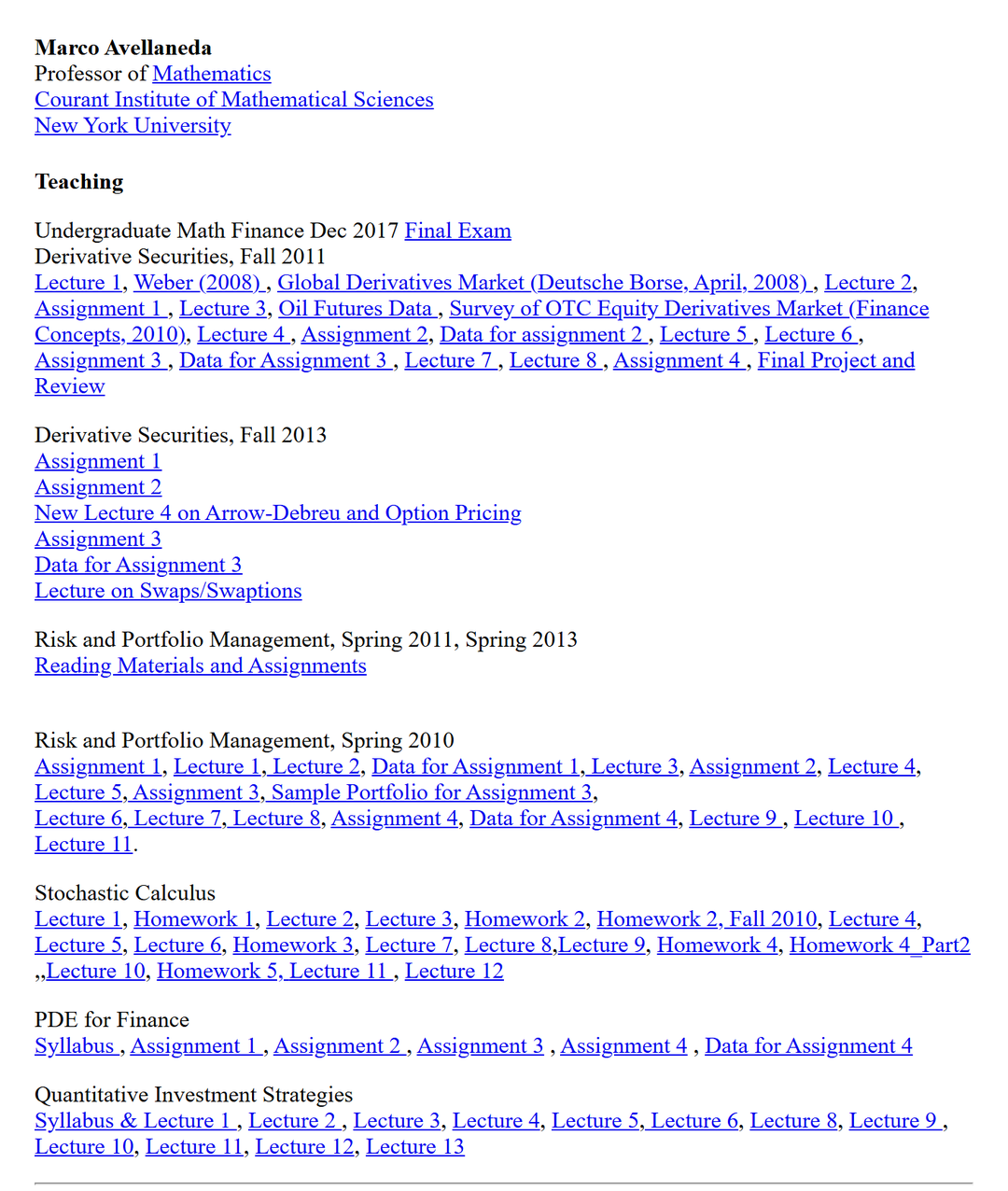
Material is specific enough to sit down and work through. Lecture 1 of Derivative Securities runs 27 slides on where the contracts came from, sourced from Weber's short history, Don Chance, and, listed without embarrassment, instructor's memory. Assignment 1 asks for the forward price of Intel one year out from a real trade date of 13 September 2011, with the closing price of $21.97 and two years of dividends handed over, then switches to a German treasurer hedging a dollar receivable with CME currency futures. Assignment 3 supplies a worksheet of every SPY option expiring January 2012 and asks for the implied dividend and the implied volatilities. Homework 4 of PDE for Finance wants a finite difference scheme for the CEV model at sigma 40% and beta minus 4, then the Riemannian metric that goes with a stochastic volatility model.
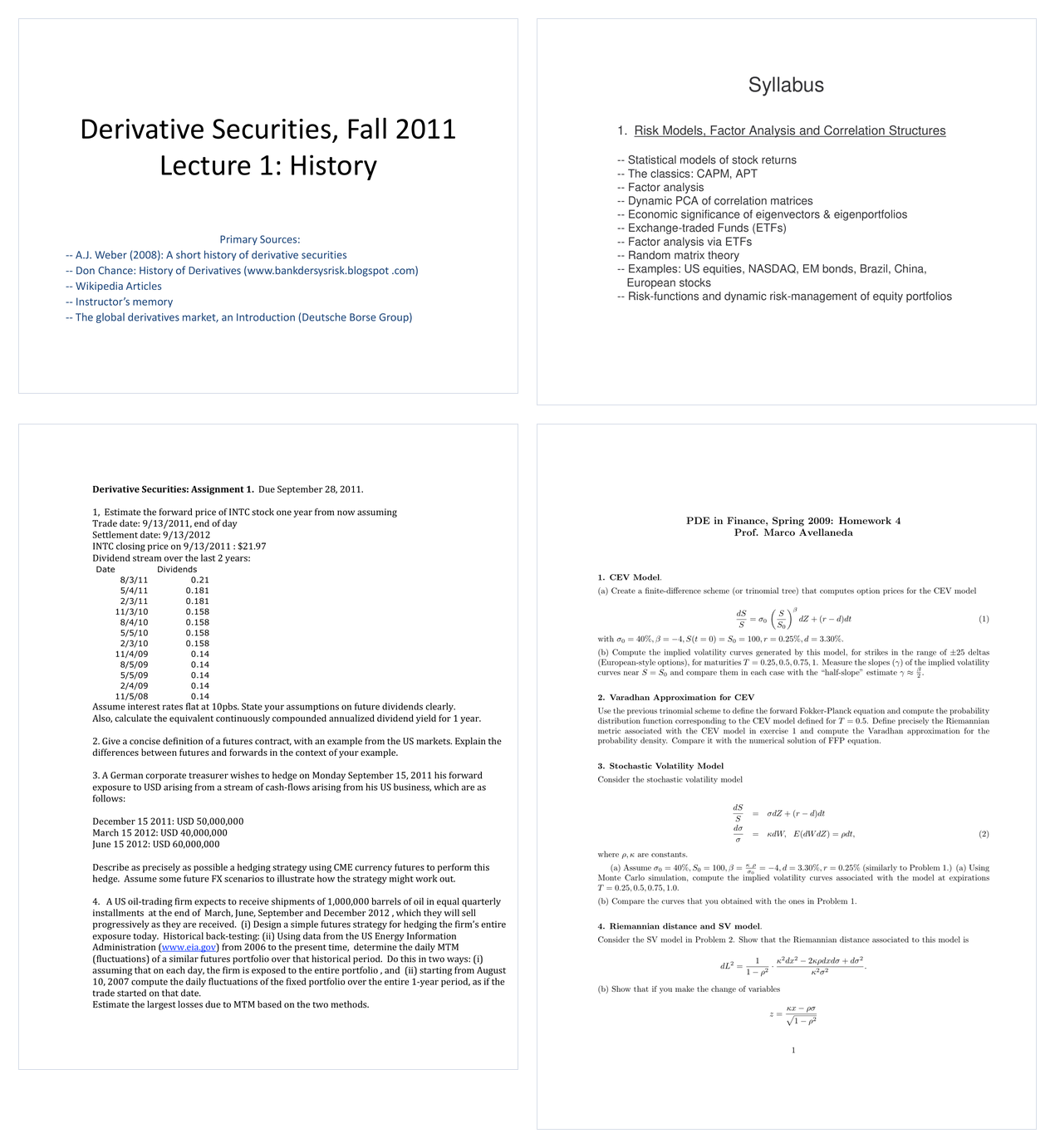
Syllabus in that top right panel is worth reading on its own. Quantitative Investment Strategies opens on statistical models of stock returns and CAPM, then goes to dynamic PCA of correlation matrices and the economic meaning of eigenportfolios, which is Avellaneda's own statistical arbitrage research turned into thirteen lectures.
Two documents on the same server are worth pulling out on their own. Modeling Volatility Risk in Equity Options, written with Doris Dobi for ICBI Global Derivatives in Amsterdam in 2014, runs 33 slides on treating volatility risk cross sectionally instead of one surface at a time. Conquering the Greeks in Monte Carlo, with Roberta Gamba, is 20 pages on getting sensitivities out of a simulation by reweighting path probabilities rather than bumping model parameters and rerunning.
Who benefits: anyone who wants graduate coursework with the problem sets attached, and anyone who would rather read a working mathematician's lecture slides than a textbook chapter. Full course listing lives in the right frame of the archive, since the page still uses a frameset.
Options models, built in Python, line by line, on screen. QuantPy has 96,300 subscribers and a catalogue that runs from delta hedging and Sharpe ratios under non normal returns through to market making and binomial pricing. Videos are long, the screen is an editor rather than a slide deck, and the code gets typed out.
Video above is a fair sample of the channel. Data comes down from a paid vendor API, which is the one cost in this whole list, and the analysis afterwards runs on tools anyone has. Halfway through, a note on screen stops to ask why one month options carry no quotes before 2020, and sends the viewer to NASDAQ's market maker quotation rules for the answer. Data problems get named instead of smoothed over, which is rare on a tutorial channel.
Who benefits: someone who can already code and wants to watch a model get assembled instead of reading its finished form. Weakest fit if the goal is theory, since derivations here are compressed to make room for implementation.
Colin Bennett ran derivatives strategy at Santander and wrote this over five years. It sells on Amazon with an ISBN, and he also puts the complete 317 page PDF on his own site for nothing. Seven chapters, ordered so the early ones suit a long only equity investor and the later ones suit a volatility desk.
Chapter 2 makes the case that variance is the tradeable quantity and volatility is the quoted one, then works through volatility, variance and gamma swaps and options on variance. Chapter 3 carries the best title in the book, Why Everything You Think You Know About Volatility Is Wrong, and spends 26 pages on why implied sits above realized, why long volatility is a poor hedge, and how structured product hedging feeds back into the surface. Chapter 7 runs from page 183 to the appendix, 46 pages on skew and term structure being two views of the same object, with the square root of time rule used to compare them. Appendix A.4 proves that a variance swap can be hedged with a log contract weighted by one over strike squared, which is the same result the Goldman paper further down builds from scratch.
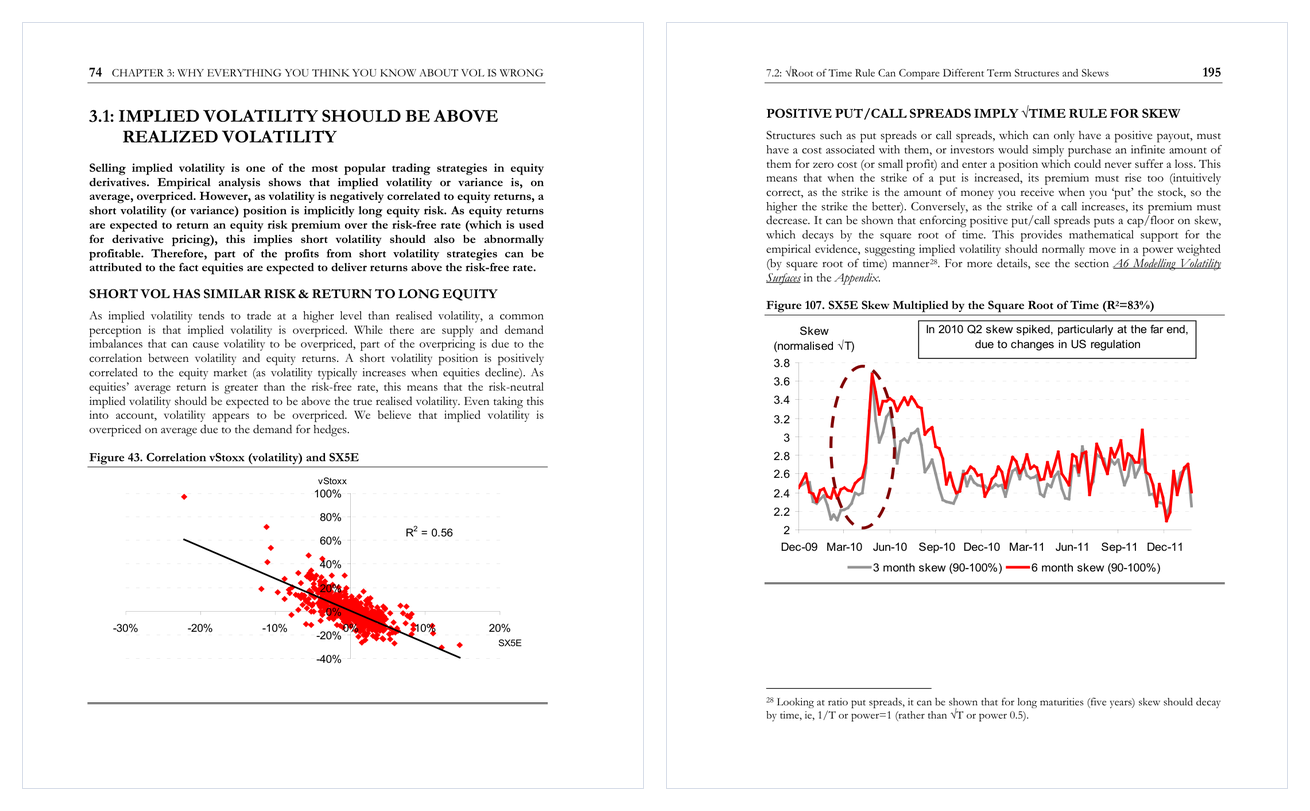
Two pages carry the flavour. Page 74 argues that implied volatility sitting above realized is partly a risk premium rather than a mispricing, since a short volatility position is implicitly long equity risk, and equities are expected to beat the risk free rate used to price the option. Figure 43 on that same page scatters vStoxx against SX5E and lands an R squared of 0.96. Page 195 gets the square root of time rule for skew out of something as plain as a put spread having to cost money, because a structure that can only pay out positively cannot be free, and then checks it on SX5E from 2009 to 2011, where dividing skew by root time collapses the three month and six month lines onto each other at 83%.
Who benefits: anyone pricing or hedging a real position. Explanations are written the way a strategist explains something to a salesperson, with the mathematics moved to an appendix so it stops interrupting.
Opposite end from QuantPy. quantpie has 24,500 subscribers, no course to sell, no sponsor read, and no code. Videos are a screen of algebra with a voice walking through every step, covering Dupire's equation, local volatility, change of numeraire, Ito's lemma and the Black-Scholes derivation from several directions.
Five years after posting, that video has 4,500 views and eleven comments, most of them from people who had already tried three other explanations. That ratio says everything about who the channel is for.
Who benefits: a reader who keeps hitting a step in a derivation that textbooks skip. Poor fit for anyone wanting a runnable notebook at the end, because that is deliberately not what this is.
Fall 2013, taught by Peter Kempthorne, Choongbum Lee, Vasily Strela and Jake Xia, and posted on OpenCourseWare with video, lecture notes and problem sets. No signup, no paywall, no certificate track holding the assignments hostage. Video gallery lists 24 lectures, numbered up to 26, with two numbers absent.
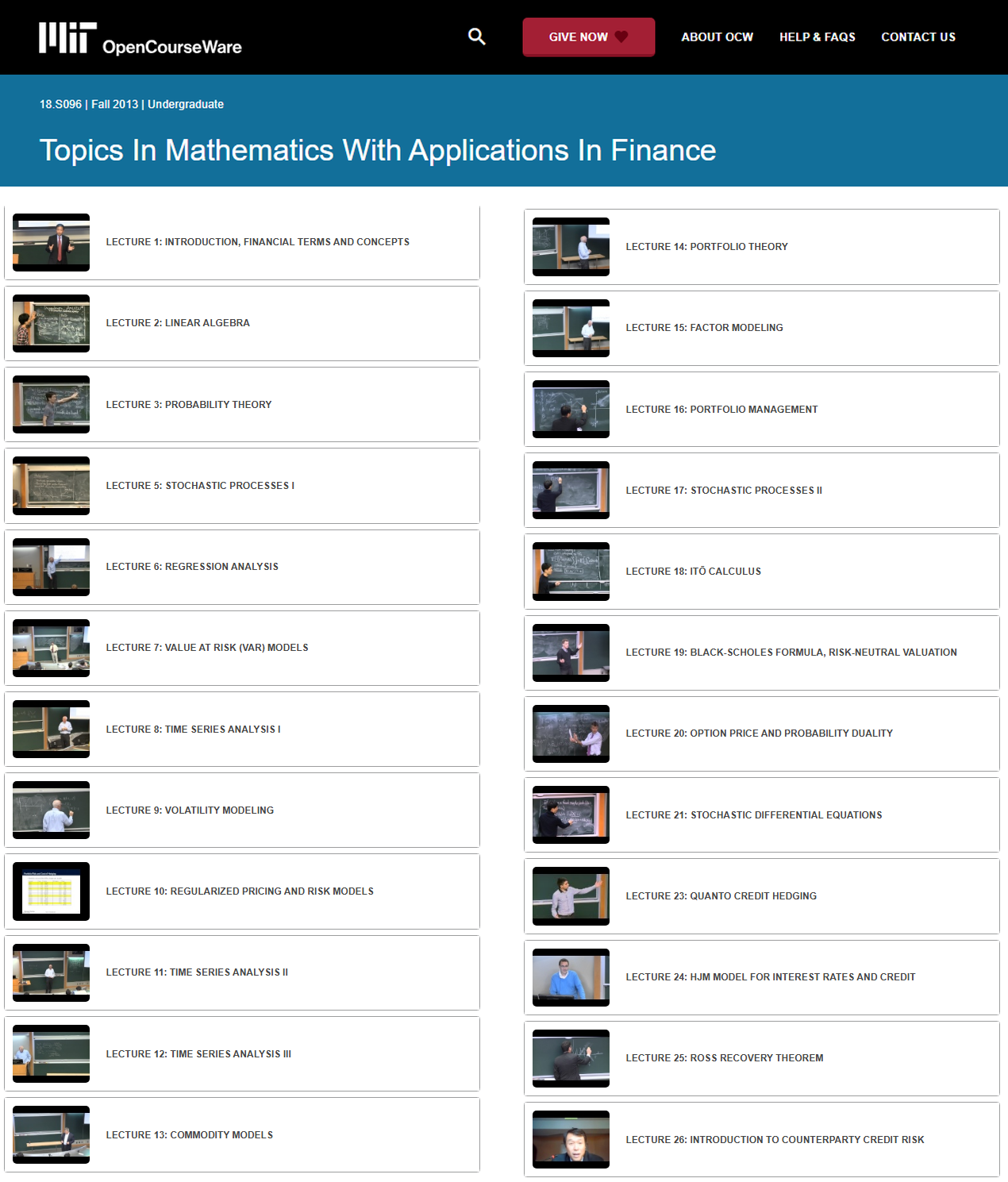
Four lectures earn the visit on their own. Lecture 9 is volatility modeling. Lecture 18 is Ito calculus. Lecture 19 derives Black-Scholes and risk neutral valuation. Lecture 20, on option price and probability duality, is the one that pays off later, since reading a price surface as a probability distribution is what makes variance swap replication feel obvious rather than clever.
Rest of the course is a solid quantitative finance foundation: linear algebra, probability, regression, value at risk, time series in three parts, portfolio theory, factor modeling, stochastic differential equations, and a closing block on HJM and counterparty credit risk.
Who benefits: a self studier who wants a fixed order and something to hand in. Lectures are classroom recordings from 2013, so production is plain and the blackboard is doing the work.
Kresimir Demeterfi, Emanuel Derman, Michael Kamal and Joseph Zou, Goldman Sachs Quantitative Strategies Research Notes, March 1999. Fifty six pages, four appendices, and a title that has been quoted in every variance swap conversation since. Derman hosts it on his own site, so it never went behind a paywall.
Argument runs in one line: a variance swap can be replicated by a static portfolio of options across all strikes, weighted inversely to the square of the strike, plus a dynamic stock position. Fair value of the swap is then the cost of that portfolio, which is why variance has a clean forward price and volatility does not.
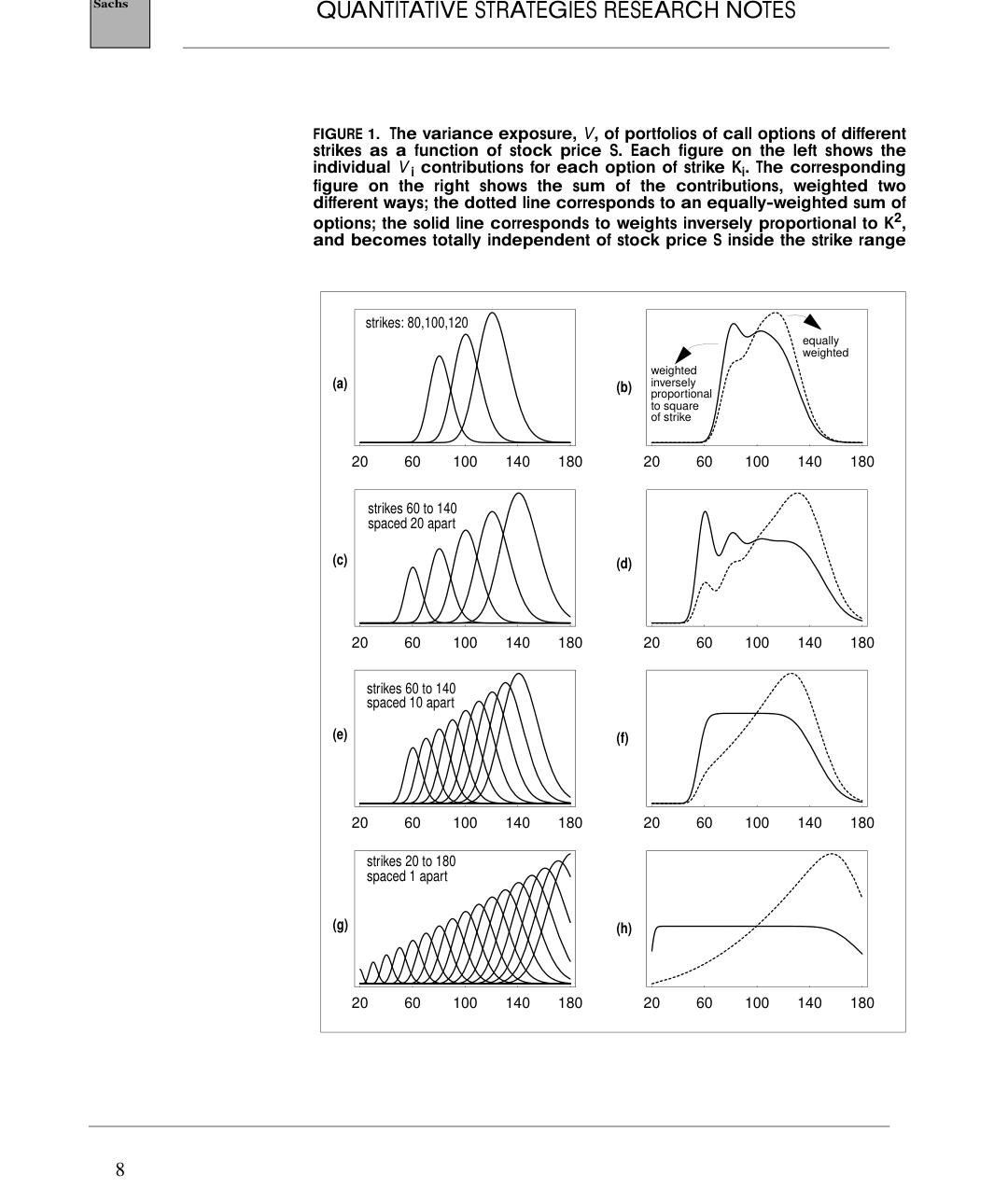
Replication section starts on PDF page 10 and is the part to read first, because it builds the intuition with three strikes before the rigorous version arrives on page 19. Afterwards come an example priced end to end, the effect of a real volatility skew, and a section on practical problems with replication, which is where the discrete strike ladder and jumps break the clean result. Reading this makes the construction of VIX obvious, since VIX is that replicating portfolio, quoted as a number.
Who benefits: anyone touching variance swaps, VIX products, or volatility targeting. Also the single best answer to why a volatility swap is harder to price than a variance swap, which the closing section handles with a convexity correction.
Columbia's Financial Engineering and Risk Management sits on Coursera and gets recommended as free constantly. Coursera's own FAQ says otherwise for this one. Course materials and graded assignments require the paid Certificate track, so audit access does not get a reader to the problem sets. Good course, wrong list.
Same test was applied to all six above. Material has to be reachable, complete, and free at the point of use, with no account and no expiring trial. Only QuantPy fails part of it, and only because one video pulls its data from a paid vendor API, while the code and the method stay open.
Free options data covers where the chains themselves come from once the reading is done. Volatility models fits several of them to real quotes. Heston volatility surface and advanced Greeks take two of the ideas above and put them in Python.